Microbiological quality assessment of drinking water sources in Tonosí, Panama, using an advanced portable analytical technique
DOI:
https://doi.org/10.14295/bjs.v5i3.821Keywords:
microbiology, membrane filtration assembly, drinking water quality, PanamaAbstract
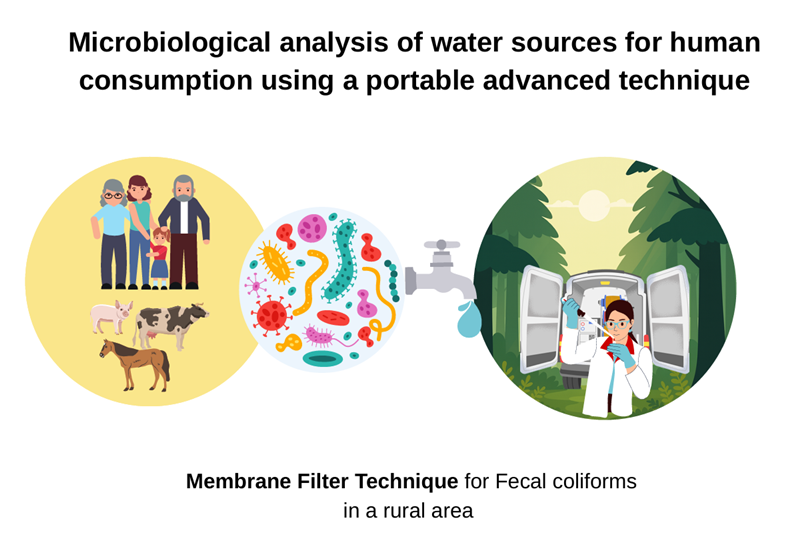
The microbiological assessment of water is crucial for public health. It is particularly significant in developing countries. This study assess the microbiological quality of water sources for human consumption in the District of Tonosí, Republic of Panama, using a portable advanced technique to detect fecal coliforms. Tonosí is a rural area, characterized by its tropical climate. Its main economic activities are agriculture and livestock. Eleven points were identified and sampled during the dry season of 2023. The Potatest 2 microbiological water quality laboratory was used to analyze the water samples. The procedure involved filtering water samples using a Membrane Filtration Unit (MFU), followed by incubation. Physicochemical parameters such as temperature, pH, residual chlorine, color, turbidity, and suspended solids were also measured. Fecal coliforms were found in most sampling points, exceeding acceptable limits according to the DGNTI-COPANIT Technical Regulation 21-2019 for drinking water in Panama. Parameters such as water temperature and pH were within regulatory standards, while some color and turbidity values slightly exceeded the limits, indicating the need for monitoring. Low residual chlorine levels suggested inadequate disinfection. The study emphasizes the importance of regular monitoring and inter-institutional collaboration for effective water quality management.
References
American Water Works Association (AWWA), Water Environment Federation (WEF), & American Public Health Association (APHA). (2022). Standard Methods for the Examination of Water and Wastewater, 24.a ed..
Bastaraud, A., Cecchi, P., Handschumacher, P., Altmann, M., & Jambou, R. (2020). Urbanization and waterborne pathogen emergence in low-income countries: Where and how to conduct surveys? International Journal of Environmental Research and Public Health, 17(2), 480. https://doi.org/10.3390/ijerph17020480 DOI: https://doi.org/10.3390/ijerph17020480
Cevallos, E. S. P., Cano, J. R. M., Ayala, M. A. G., & Jaramillo, M. E. N. (2018). Enfermedades transmitidas por el consumo de agua contaminada. Metanoia; Revista de Ciencia, Tecnología e Innovación, 4(6).
Evans, E. (2023). Cambio Climático y sus efectos sociales en el distrito de Tonosí, provincia de Los Santos. Revista Panameña de Ciencias Sociales, (7).
Guevara, J. E. O., Broce, K., Gómez Zanetti, N. A., Henríquez, D., Ellis, C., & Mack-Vergara, Y. L. (2025). The impact of a mobile laboratory on water quality assessment in remote areas of Panama. Sustainability, 17(15), 7096. https://doi.org/10.3390/su17157096 DOI: https://doi.org/10.3390/su17157096
Instituto de Meteorología e Hidrología de Panamá. (2023). Datos Climáticos Históricos. Instituto de Meteorología e Hidrología de Panamá. https://www.imhpa.gob.pa/es/clima-historicos
Instituto Nacional de Estadística y Censo. (2012). División político administrativa de la República de Panamá, provincia de los santos, distrito de Tonosí, por corregimiento año: 2010. https://www.inec.gob.pa/archivos/0.0719675409_Distrito_Tonosi.pdf
Instituto Nacional de Estadística y Censo. (2023). Cuadro 10. Superficie, población y densidad de población en la República, según provincia, comarca indígena, distrito y corregimiento: Censos de 2000, 2010 y 2023. https://www.inec.gob.pa/archivos/P0705547520231109105354CUADRO%2010.pdf
ISO. (2023). ISO 7704:2023(en), Calidad del agua. Requisitos para las pruebas de rendimiento de filtros de membrana utilizados para la enumeración directa de microorganismos mediante métodos de cultivo. https://www.iso.org/obp/ui/en/#iso:std:iso:7704:ed-2:v1:en
Khan, K., Lu, Y., Saeed, M. A., Bilal, H., Sher, H., Khan, H., Ali, J., Wang, P., Uwizeyimana, H., Baninla, Y., Li, Q., Liu, Z., Nawab, J., Zhou, Y., Su, C., & Liang, R. (2018). Prevalent fecal contamination in drinking water resources and potential health risks in Swat, Pakistan. Journal of Environmental Sciences, 72, 1-12. https://doi.org/10.1016/j.jes.2017.12.008 DOI: https://doi.org/10.1016/j.jes.2017.12.008
Küpper, T., Apel, C., Bertsch, D., van der Giet, M., van der Giet, S., Graß, M., Cerfontaine, C., Haunolder, M., Hundt, N., Kühn, C., Morrison, A., Museo, S., Timmermann, L., Wernitz, K., & Jäger, J. (2022). Analysis of local drinking water for fecal contamination in Solu-Khumbu/Mt. Everest region, Nepal. International Journal of Hygiene and Environmental Health, 246, 114043. https://doi.org/10.1016/j.ijheh.2022.114043 DOI: https://doi.org/10.1016/j.ijheh.2022.114043
Lin, L., Yang, H., & Xu, X. (2022). Effects of Water Pollution on Human Health and Disease Heterogeneity: A Review. Frontiers in Environmental Science, 10. https://doi.org/10.3389/fenvs.2022.880246 DOI: https://doi.org/10.3389/fenvs.2022.880246
Magana-Arachchi, D. N., & Wanigatunge, R. P. (2020). Chapter 2—Ubiquitous waterborne pathogens. En M. N. Vara Prasad & A. Grobelak (Eds.), Waterborne Pathogens, 15-42. Butterworth-Heinemann. https://doi.org/10.1016/B978-0-12-818783-8.00002-5 DOI: https://doi.org/10.1016/B978-0-12-818783-8.00002-5
Ministerio de Comercio e Industrias. (2019). Reglamento Técnico DGNTl-COPANIT 21-2019 Tecnología de los Alimentos, Agua Potable. Definiciones y Requisitos Generales. https://faolex.fao.org/docs/pdf/pan190168.pdf
Moreno, A., Aguirre, M., & De La Cruz, A. (2025). Insufficient chlorination as the critical determinant of microbiological non-compliance in rural water systems: First integrated assessment in Azuero, Panama. BioNatura Journal: Ibero-American Journal of Biotechnology and Life Sciences, 2(4), 12-12. https://doi.org/10.70099/BJ/2025.02.04.15 DOI: https://doi.org/10.70099/BJ/2025.02.04.15
National Research Council. (1980). The Disinfection of Drinking Water. In: Drinking Water and Health: Volume 2. National Academies Press (US). https://www.ncbi.nlm.nih.gov/books/NBK234590/
Nelson, K. L., & Erickson, J. (2016). Intermittent supply in the context of efforts to improve piped drinking water supply in Latin America and the Caribbean: Lessons from a case study in Arraiján, Panama. IDB Publications. (Panama). https://publications.iadb.org/en/publication/17204/intermittent-supply-context-efforts-improve-piped-drinking- DOI: https://doi.org/10.18235/0010667
water-supply-latin
Organización Mundial de la Salud. (2009). Medición del cloro residual en el agua. http://www.disaster-
info.net/Agua/pdf/11-CloroResidual.pdf
Palintest. (2011). Potalab®+ (M) Advanced Portable Water Quality Laboratory (Microbiological). https://www.palintest.com/products/potatest-classic/
Paramo, L., Garmendia, T., Villalta, J., & Domínguez. (2018). Herramientas moleculares para estudiar las aguas de consumo humano del Cacao, Monzonte, Nueva Segovia, Nicaragua. Nexo Revista Científica, 31, 01-15. https://doi.org/10.5377/nexo.v31i01.6450 DOI: https://doi.org/10.5377/nexo.v31i01.6450
Perez, E. (2021). Análisis de Situación de Salud, CSS región de Los Santos. https://planificacion.css.gob.pa/wp-content/uploads/2021/12/Ana%CC%81lisis-de-Situacio%CC%81n-Los-Santos-2021.pdf
Sánchez, C. C. (2018). Enfermedades infecciosas relacionadas con el agua en el Perú. Revista Peruana de Medicina Experimental y Salud Pública, 309-316. https://doi.org/10.17843/rpmesp.2018.352.3761 DOI: https://doi.org/10.17843/rpmesp.2018.352.3761
WHO. World Health Organization. (2022). Guidelines for drinking-water quality: Fourth edition incorporating the first and second addenda. https://www.who.int/publications-detail-redirect/9789240045064
Downloads
Published
How to Cite
Issue
Section
License
Copyright (c) 2026 Natasha Alejandra Gómez-Zanetti, Dina Henríquez, Kathia Tamara Broce, Jorge Enrique Olmos Guevara, Yazmin Lisbeth Mack-Vergara

This work is licensed under a Creative Commons Attribution 4.0 International License.
Authors who publish with this journal agree to the following terms:
1) Authors retain copyright and grant the journal right of first publication with the work simultaneously licensed under a Creative Commons Attribution License that allows others to share the work with an acknowledgement of the work's authorship and initial publication in this journal.
2) Authors are able to enter into separate, additional contractual arrangements for the non-exclusive distribution of the journal's published version of the work (e.g., post it to an institutional repository or publish it in a book), with an acknowledgement of its initial publication in this journal.
3) Authors are permitted and encouraged to post their work online (e.g., in institutional repositories or on their website) prior to and during the submission process, as it can lead to productive exchanges, as well as earlier and greater citation of published work.