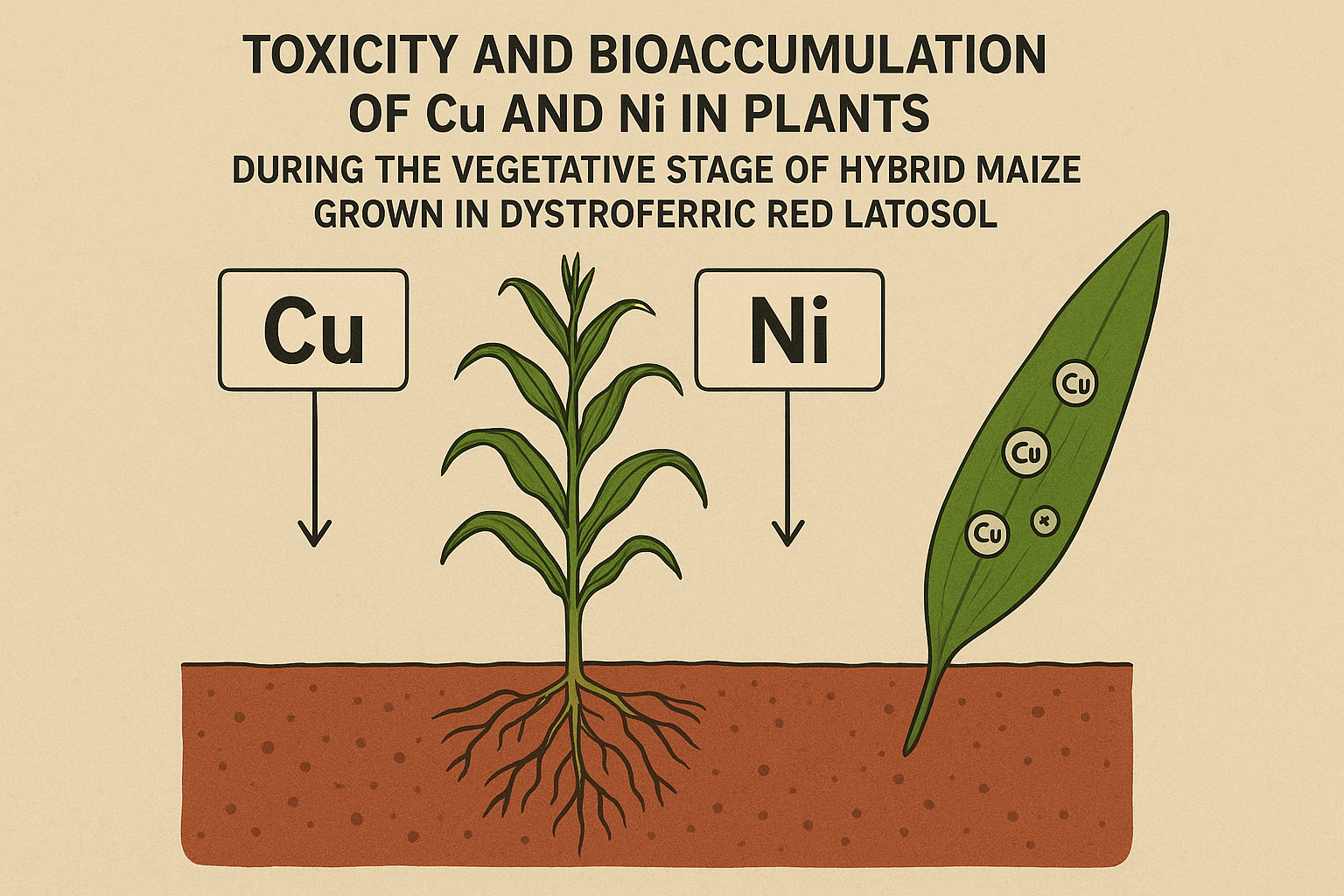
Toxicity and bioaccumulation of Cu and Ni in plants during the vegetative stage of hybrid maize grown in dystroferric red latosol
DOI:
https://doi.org/10.14295/bjs.v5i1.816Keywords:
toxic effects of heavy metals, micronutrients, Zea mays L., roots, soil contaminationAbstract
Heavy metals such as Cu2+ and Ni2+ can promote bioaccumulation and induce phytotoxic effects in various plant groups, including agriculturally important species such as maize (Zea mays L.). In this study, we assessed the effects of different concentrations of these metals, which act as micronutrients at low levels but become toxic at elevated doses. Increasing concentrations of Cu and Ni (mg L-1) were applied via nutrient solution to dystroferric Red Latosol cultivated with the hybrid maize Pioneer P3601 PWU. The experiment was conducted in a greenhouse and evaluated at the V5 growth stage. Our results showed that concentrations above 5 mg L-1 impaired both shoot and root development, with severely toxic effects observed at the highest concentrations (350 and 600 mg L-1). We conclude that Cu and Ni levels exceeding 5 mg L-1 negatively affect the vegetative growth of hybrid maize and exhibit significant translocation between roots and shoots, ultimately compromising plant development.
References
Adriano, D. C. (1986). Trace elements in the terrestrial environment. New York: Springer-Verlag, 533 p. DOI: https://doi.org/10.1007/978-1-4757-1907-9
Akhtar, M. T., Lu, Z., Ren, S-X., Zou, H-L., Noor, I., & Jin, B. (2026). Cooper homeostasis: Crosstalk with plant secondary metabolism and stress responses. Plant Science, 362, 112796. https://doi.org/10.1016/j.plantsci.2025.112795 DOI: https://doi.org/10.1016/j.plantsci.2025.112795
Amanullah, F., & Khan, W-ud-D. (2023). Trichoderma asperellum L. coupled the effects of biochar to enhance the growth and physiology of contrasting maize cultivars under copper and nickel stresses. Plants12(4), 958. https://doi.org/10.3390/plants12040958 DOI: https://doi.org/10.3390/plants12040958
Amjad, M., Raza, H., Murtaza, B., Abbas, G., Imran, M., Shahid, M., Naeem, M. A., Zakir, A., & Iqbal, M. M. (2020). Plants, 9(1), 5. https://doi.org/10.3390/plants9010005 DOI: https://doi.org/10.3390/plants9010005
Andresen, E., & Küpper, H. (2013). Cadmium toxicity in plants. In: Astrid, S., & Sigel, H, editors. Cadmium: From toxicity to essentiality. Springer Netherlands, 395-413 p. DOI: https://doi.org/10.1007/978-94-007-5179-8_13
Berton, R. S., Pires, A. M. M., Andrade, S. A. L., Abreu, C. A., Ambrosano, E. J., & Silveira, A. P. D. (2006). Toxicidade do níquel em plantas de feijão e efeitos sobre a microbiota do solo. Pesquisa Agropecuária Brasileira, 41(8), 1305-1312. https://doi.org/10.1590/S0100-204X2006000800014 DOI: https://doi.org/10.1590/S0100-204X2006000800014
Bouzayani, B., Lomba-Fernández, B., Fdez-Sanromán, A., Elaoud, S. C., & Sanromán, M. Á. (2024). Advancements in copper-based catalysts for efficient generation of reactive oxygen species from peroxymonosulfate. Applied Sciences, 14(17), 8075. https://doi.org/10.3390/app14178075 DOI: https://doi.org/10.3390/app14178075
Boros-Lajszner, E., Wyszkowska, J., & Kucharski, J. (2025). Biochar as a stimulator of Zea mays growth and enzyme activity in soil contaminated with zinc, copper, and nickel. Agronomy, 15(7), 1543. https://doi.org/10.3390/agronomy15071543 DOI: https://doi.org/10.3390/agronomy15071543
Brown, P. H., Welch, R. M., & Cary, E. E. (1987a). Nickel: a micronutrient essential for higher plants. Plant Physiology, 85, 801-803. DOI: https://doi.org/10.1104/pp.85.3.801
Brown, P. H., Wlch, R. M., Cary, E. E., & Checkai, R. T. (1987b). Micronutrients. Beneficial effects of nickel on plant growth. Journal of Plant Nutrition, 10(9-16), 2125-2135. DOI: https://doi.org/10.1080/01904168709363763
Chen, G., Li, J., Han, H., Du, R., & Wang, X. (2022). Physiological and molecular mechanisms of plant responses to copper stress. International Journal of Molecular Sciences, 23(21), 12950. https://doi.org/10.3390/ijms232112950 DOI: https://doi.org/10.3390/ijms232112950
Cheraghvareh, L., Pourakbar, L., Moghaddam, S. S., & Xiao, J. (2024). The effect of biofertilizers on nickel accumulation, nitrogen metabolism and amino acid profile of corn (Zea mays L.) exposed to nickel stress. Environmental Science and Pollution Research, 31, 49498-49513. https://doi.org/10.1007/s11356-024-34507-z DOI: https://doi.org/10.1007/s11356-024-34507-z
Ghori, N. H., Ghori, T., Hayat, M. Q., Imadi, S. R., Gul, A., Altay, V. (2019). Heavy metal stress and responses in plants. Int J Env Sci Technol, 16(3), 1807-1828. DOI: https://doi.org/10.1007/s13762-019-02215-8
Kicińska, A., Pomykala, R., & Izquierdo-Diaz, M. (2022). Changes in soil pH and mobility of heavy metals in contaminated soils. European Journal of Soil Science, 73(1), e13203. https://doi.org/10.1111/ejss.13203 DOI: https://doi.org/10.1111/ejss.13203
Krupa, Z., Siedlecka, A., Maksymiec, W., & Baszynski, Y. T. (1993). In vivo response of photosynthetic apparatus of Phaseolus vulgaris L. to nickel toxicity. Journal of Plant Physiology, 142, 664-668. DOI: https://doi.org/10.1016/S0176-1617(11)80899-0
Kuinchtner, C. C., Aguilar, M. V. M., Senhor, D. F., Birck, T. P., Brunetto, G., & Tabaldi, L. A. (2023). Morpho-physiological and biochemical mechanisms of copper tolerance in Handroanthus heltaphyllus. Ciência e Agrotecnologia, 47, e011322. http://dx.doi.org/10.1590/1413-7054202347011322 DOI: https://doi.org/10.1590/1413-7054202347011322
Kumar, S., Wang, M., Liu, Y., Fahad, S., Qayyum, A., Jadoon, S. A., Chen, Y., & Zhu, G. (2022). Nickel toxicity alters growth patterns and induces oxidative stress response in sweetpotato. Frontiers in Plant Science, 10(13), 1054924. https://doi.org/10.3389/fpls.2022.1054924 DOI: https://doi.org/10.3389/fpls.2022.1054924
Li, R., Zhang, J., Li, Z., Peters, R. J., & Yang, B. (2022). Dissecting the labdane-related diterpenoid biosynthetic gene clusters in rice reveals directional cross-cluster phytotoxicity. New Phytology, 233(2), 878-889. https://doi.org/10.1111/nph.17806 DOI: https://doi.org/10.1111/nph.17806
Nazarova, A. A. (2022). The effect of a mixture of iron and nickel nanopowders of various concentrations on the growth and yield of corn. IOP Conference Series: Earth and Environmental Science, 1045, 012151. DOI 10.1088/1755-1315/1045/1/012151 DOI: https://doi.org/10.1088/1755-1315/1045/1/012151
Oliveira, L. M., Araujo, M. U. P., Silva, B. N., Chaves, J. A. A., Pinto, L. F. C. C., Silveira, P. R., Ribeiro, D. M., & Rodrigues, F. À. (2022). Maize resistance to northern corn leaf blight is potentiated by nickel. Plant Pathology, 71(2), 262-278. https://doi.org/10.1111/ppa.13481 DOI: https://doi.org/10.1111/ppa.13481
Paiva, H. N., Carvalho, J. G., Siqueira, J. O., Fernandes, A. R., & Miranda, J. R. P. (2003). Efeito da aplicação de doses crescentes de níquel sobre o teor e o conteúdo de nutrientes em mudas de ipê-roxo (Tabebuia impetiginosa (Mart.) Standley). Scientia Forestalis, 63, 158-166. DOI: https://doi.org/10.1590/S0100-67622003000200005
Panda, S. K., Gupta, D., Patel, M., Vyver, C. V. D., & Koyama, H. (2024). Functionality of reactive oxygen species (ROS) in plants: Toxicity and control in Poaceae crops exposed to abiotic stress. Plants, 13(15), 2071. https://doi.org/10.3390/plants13152071 DOI: https://doi.org/10.3390/plants13152071
Park, Y. J., Kim, N. S., Sathasivam, R., Chung, Y. S., & Park, S. U. (2022). Impact of copper treatment on phenylpropanoid biosynthesis in adventitious root culture of Althaea officinalis L. Preparative Bioachemistry & Biotechnology, 52(3), 283-291. https://doi.org/10.1080/10826068.2021.1934697 DOI: https://doi.org/10.1080/10826068.2021.1934697
Rasheed, M. M., Saeed, I. O, & Ibrahim, O. M. (2024). Concentrations of some heavy metals in plants adjacent to the Tigris River, Iraq. Nativa, 12(1), 191-194. https://doi.org/10.31413/nativa.v12i1.17292 DOI: https://doi.org/10.31413/nat.v12i1.17292
Rabeh, K., Hnini, M., & Oubohssaine, M. (2025). A comprehensive review of transcription factor-mediated regulation of secondary metabolites in plants under environmental stress. Stress Biology, 5. https://doi.org/10.1007/s44154-024-00201-w DOI: https://doi.org/10.1007/s44154-024-00201-w
Silva Filho, E. C., Silva Neto, G. M., Castro, C. F. S., Rocha, E. N., Ventura, M. V. A., & Menezes Filho, A. C. P. M. (2025). Influence of NiSO4 doses on agronomic and bioaccumulative parameters in maize (Zea mays) plants during the vegetative stage. Brazilian Journal of Science, 4(7), 15-22. DOI: https://doi.org/10.14295/bjs.v4i7.759
Tipu, M. I., Ashraf, M. Y., Sarwar, N., Akhtar, M., Shaheen, M. R., Ali, S., & Damalas, C. A. (2020). Growth and physiology of maize (Zea mays L.) in a Nickel-contaminated soil and phytoremediation efficiency using EDTA. Journal of Plant Growth Regulation, 40, 774-786. https://doi.org/10.1007/s00344-020-10132-1 DOI: https://doi.org/10.1007/s00344-020-10132-1
Tóth, G., Hermann, T., Da Silva, M. R., & Montanarella, L. (2016). Heavy metals in agricultural soils of the European Union with implications for food safety. Environ Int, 88, 299-309. DOI: https://doi.org/10.1016/j.envint.2015.12.017
Tubotu, F. K., Akporhonor, E. E., & Agbaire, P. O. (2024). Growth and cadmium and nickel uptake of maize (Zea mays L.) in a cadmium and nickel co-contaminated soil and phytoremediation efficiency using ethylenediamine tetraacetic acid. International Journal of Scientific Reports, 10(5), 141-147. https://dx.doi.org/10.18203/issn.2454-2156.IntJSciRep20240977 DOI: https://doi.org/10.18203/issn.2454-2156.IntJSciRep20240977
Uren, N.C. (1992). Forms, reaction and availability of nickel in soils. Advances in Agronomy, 48,141-203. DOI: https://doi.org/10.1016/S0065-2113(08)60937-2
Vasilachi-Mitoseru, I.-C., Stoleru, V., & Gavrilescu, M. (2023). Integrated assessment of Pb(II) and Cu(II) metal ion phytotoxicity on Medicago sativa L., Triticum aestivum L., and Zea mays L. plants: Insights into germination inhibition, seedling development, and ecosystem health. Plants, 12(21), 3754. https://doi.org/10.3390/plants12213754 DOI: https://doi.org/10.3390/plants12213754
Zheng, J., XIE, X., Li, C., Wang, H., Yu, Y., & Huang, B. (2023). Regulation mechanism of plant response to heavy metal stress mediated by endophytic fungi. International Journal of Phytoremediation, 25(12), 1596-1613. https://doi.org/10.1080/15226514.2023.2176466 DOI: https://doi.org/10.1080/15226514.2023.2176466
Zhou, X., An, Y., Qu, T., Jin, T., Zhao, L., Guo, H., Wang, W., & Zhao, C. (2024). Effects of Ni and Cu stresses on morphological and physiological characteristics of Euphorbia marginata pursh seedlings. Agronomy, 14(6), 1223. https://doi.org/10.3390/agronomy14061223 DOI: https://doi.org/10.3390/agronomy14061223
Xu, E., Liu, Y., Gu, D., Zhan, X., Li, J., Zhou, K., Zhang, P., & Zou, Y. (2024). Molecular mechanisms of plant responses to cooper: From deficiency to excess. International Journal of Molecular Sciences, 25(13), 6993. https://doi.org/10.3390/ijms25136993 DOI: https://doi.org/10.3390/ijms25136993
Wang, C-C., Zhang, Q-C., Kang, S-G., Li, M-Y., Zhang, M-Y., Xu, W-M., Xiang, P., & Ma, L. Q. (2023). Heavy metal (loid)s in agricultural soil from main grain production regions of China: Bioaccessibility and health risks to humans. Science of The Total Environment, 858(2), 159819. https://doi.org/10.1016/j.scitotenv.2022.159819 DOI: https://doi.org/10.1016/j.scitotenv.2022.159819
Wiggenhauser, M., Illmer, D., Spiess, E., Holkämper, A., Prasuhn, V., & Liebisch, F. (2024). Cadmium, zinc, and copper leaching rates determined in large monolith lysimeters. Science of The Total Environment, 926, 171482. https://doi.org/10.1016/j.scitotenv.2024.171482 DOI: https://doi.org/10.1016/j.scitotenv.2024.171482
Downloads
Published
How to Cite
Issue
Section
License
Copyright (c) 2026 João Vitor Ramos da Silva Dantas, Roberto Castro Pereira Filho, Matheus Vinicius Abadia Ventura, Antonio Carlos Pereira de Menezes Filho

This work is licensed under a Creative Commons Attribution 4.0 International License.
Authors who publish with this journal agree to the following terms:
1) Authors retain copyright and grant the journal right of first publication with the work simultaneously licensed under a Creative Commons Attribution License that allows others to share the work with an acknowledgement of the work's authorship and initial publication in this journal.
2) Authors are able to enter into separate, additional contractual arrangements for the non-exclusive distribution of the journal's published version of the work (e.g., post it to an institutional repository or publish it in a book), with an acknowledgement of its initial publication in this journal.
3) Authors are permitted and encouraged to post their work online (e.g., in institutional repositories or on their website) prior to and during the submission process, as it can lead to productive exchanges, as well as earlier and greater citation of published work.