Root rot caused by Macrophomina phaseolina: Epidemiology, symptoms, and management in crops
DOI:
https://doi.org/10.14295/cerrado.v3i3.940Keywords:
Macrophomina genus, Root rot, Soilborne pathogen, Phytopathogen, Integrated managementAbstract
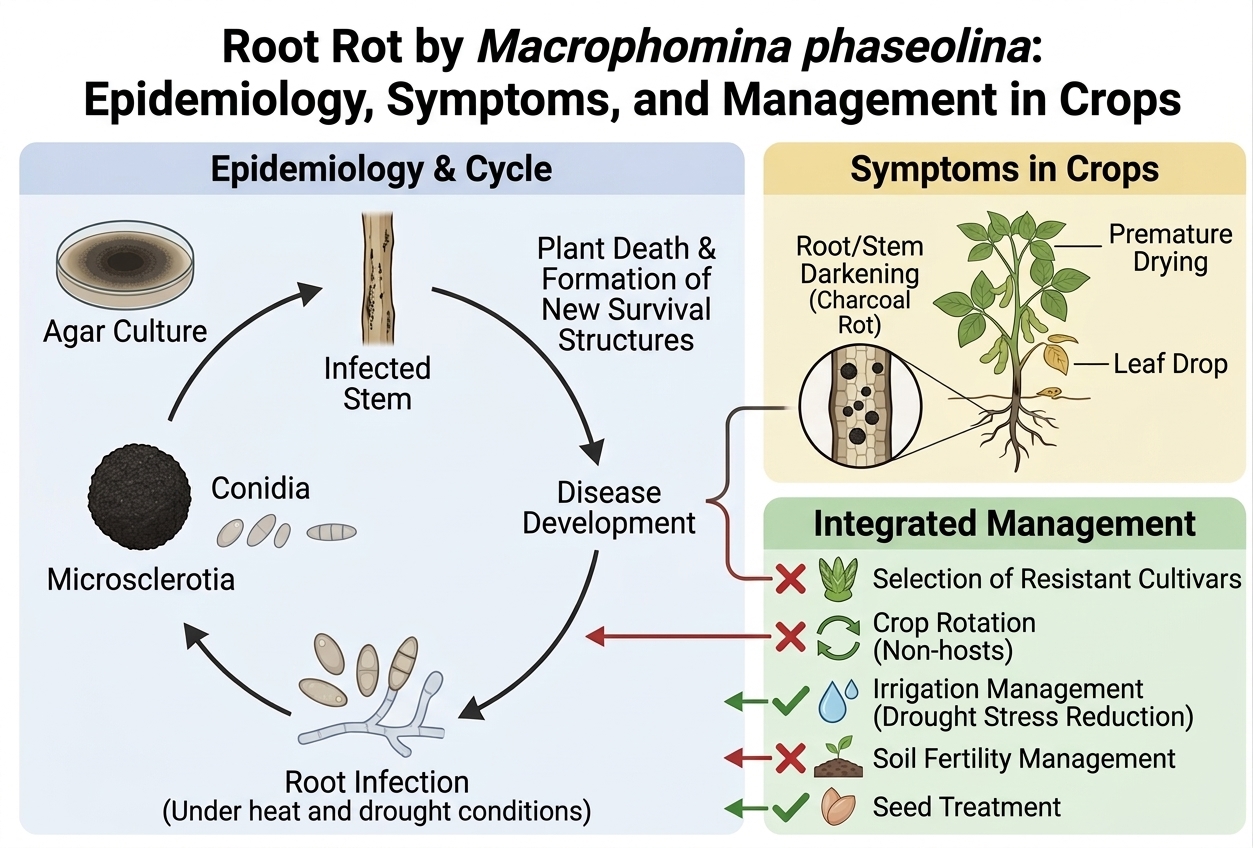
Root rot caused by Macrophomina phaseolina is one of the most economically important soilborne diseases, affecting several crops, including soybean, maize, cotton, and common bean. This study aimed to conduct a literature review on the epidemiology, symptomatology, diagnosis, and management of this pathogen. M. phaseolina exhibits a high survival capacity in soil due to the formation of microsclerotia and is favored by high temperatures and water deficit conditions. Infection compromises the root system, reducing water and nutrient uptake and causing symptoms such as root necrosis, wilting, premature senescence, and yield reduction. Disease diagnosis can be performed through field symptom assessment, fungal isolation, and molecular techniques such as polymerase chain reaction (PCR). Disease management is primarily based on integrated strategies, including crop rotation, the use of resistant cultivars, proper soil management, and biological control. Therefore, understanding the biology and epidemiology of Macrophomina phaseolina is essential for developing effective control measures and reducing agricultural losses associated with the disease.
References
Abo-Elyousr, K. A. M., Almasoudi, N. M., Rahman, M. M., El-Fawy, M. M., Bagy, H. M. K., & Sallam, N. M. A. Biological control of charcoal rot disease of soybean, Macrophomina phaseolina, using Streptomyces spp. isolates. European Journal of Plant Pathology, 174, 1039-1050, 2026. https://doi.org/10.1007/s10658-026-03184-8
Awoke, R. W., Okello, D., Mafurah, J., & Kimurto, P. Agricultural technologies and practices for groundnut diseases management in Africa: A review. Discover Agriculture, 3, 2025. https://doi.org/10.1007/s44279-025-00377-3
Campolat, S., Tülek, S., Yağmur, A., Duman, K., Karayel, R., Atmaca, E., & Kilinç, A. T. Screening some bean genotypes for resistance to Macrophomina phaseolina in Türkiye. Biodiversity Studies, 1(1), 13-20, 2022.
Castro-Diego, J. A., López-Orina, C. A., Sánchez-Gómez, O. A., Edeza-Urías, J. A., Gómez-González, G., Armenta-Moreno, E. J., Rubio-Aragón, J. O., & Rubio-Aragón, W. A. First report of charcoal rot of Lagenaria siceraria caused by Macrophomina phaseolina in Mexico. Plant Disease, 110(2), 2026. https://doi.org/10.1094/PDIS-07-25-1414-PDN
da Costa, R. V., Souza, M. R., Almeida, R. E. M., Cota, L. V., Silva, D. D., & Silva, F. R. Incidence of charcoal rot (Macrophomina phaseolina) in maize hybrids in different environments during off-season. International Journal of Maize & Sorghum, 22, 2023. https://doi.org/10.18512/rbms2023v22e1319
Degani, O., Gordani, A., Dimant, E., Chen, A., & Rabinovits, O. The cotton charcoal rot causal agent, Macrophomina phaseolina, biological and chemical control. Frontiers in Plant Science, 14, 2023. https://doi.org/10.3389/fpls.2023.1272335
Degani, O., Chen, A., Dimant, E., Gordani, A., Malul, T., & Rabinovitz, O. Integrated management of the cotton charcoal rot disease using biological agents and chemical pesticides. Journal of Fungi, 10(4), 250, 2024. https://doi.org/10.3390/jof10040250
Dilkin, E. R. S., Matias, R., Oliveira, A. K. M., & Corrêa, B. O. Fungitoxic effect and phytochemical characteristics of brazilian Cerrado against Rhizoctonia solani and Macrophomina phaseolina fungi. Brazilian Journal of Biology, 84, e263114, 2022. https://doi.org/10.1590/1519-6984.263114
Elez, J., Petrović, K., Crnković, M., Krsmanović, S., Rajković, M., Kaitović, M., & Malenčić, Đ. Susceptibility of the most popular soybean cultivars in South-East Europe to Macrophomina phaseolina (Tassi) Goid. Plants, 12(13), 2467, 2023. https://doi.org/10.3390/plants12132467
Farag, P. F., Alkhalifah, D. H. M., Ali, S. K., Tagyan, A. I., & Hozzein, W. N. Impact of climate change on the potential global prevalence of Macrophomina phaseolina (Tassi) Goid. under several climatological scenarios. Frontiers in Plant Science, 16, 2025. https://doi.org/10.3389/fpls.2025.1512294
Farr, D. F., & Rossman, A. Y. Fungal databases, U.S. National Fungus Collections, 2024. https://nt.ars-grin.gov/fungaldatabases/
Ghosh, T., Biswas, M. K., Guin, C., & Roy, P. A review on characterization, therapeutic approaches and pathogenesis of Macrophomina phaseolina. Plant Cell Biotechnology and Molecular Biology, 19(3&4), 72-84, 2018.
Gupta, G. K., Sharma, S. K., & Ramteke, R. Biology, epidemiology and management of the pathogenic fungus Macrophomina phaseolina with special reference to charcoal rot of soybean. Journal of Phytopathology, 160(4), 167-180, 2012. https://doi.org/10.1111/j.1439-0434.2012.01884.x
Islam, M. S., Haque, S., Islam, M. M., Emdad, E., Halim, A., Hossen, Q. M. M., Hossain, M. Z., Ahmed, B., Rahim, S., Rahman, M. S., Alam, M. M., Hou, S., Wan, X., Saito, J. A., & Alam, M. Tools to kill: Genome of one of the most destructive plant pathogenic fungi, Macrophomina phaseolina. BMC Genomics, 13, 493, 2012. https://doi.org/10.1186/1471-2164-13-493
Jaber, M. A., & Fayyadh, M. A. Biological control of charcoal rot disease caused by Macrophomina phaseolina (Tassi) Goid on cowpea and mung bean by some isolates of Streptomyces spp. Basrah Journal of Agricultural Sciences, 32(2), 207-219, 2019. https://doi.org/10.37077/25200860.2019.269
Júnior, R. S., Neto, A. N. S., Negreiros, A. M. P., Gomes, T. R. R., Ambrósio, M. M. Q., & Armengol, J. Pathogenicity of Macrophomina species collected from weeds in cowpea. Revista Caatinga, 33(2), 395-401, 2020. http://dx.doi.org/10.1590/1983-21252020v33n212rc
Kaur, S., Kumari, N., Parmar, P., & Sharma, V. Simultaneous exposure of contrasting Vigna radiata cultivars to Macrophomina phaseolina infection and drought stress: morpho-physiological and biochemical implications. Plant Biosystems – An International Journal Dealing with all Aspects of Plant Biology, 157(5), 1100-1113, 2023. https://doi.org/10.1080/11263504.2023.2243942
Kaur, S., Dhillon, G. S., Brar, S. K., Vallad, G. E., Chand, R., & Chauhan, V. B. Emerging phytopathogen Macrophomina phaseolina: biology, economic importance and current diagnostic trends. Critical Reviews in Microbiology, 38(2), 136-151, 2012. https://doi.org/10.3109/1040841X.2011.64097
Khalili, E., Kamyab, H., Balasubramanian, B., & Chelliapan, S. Integrated management of charcoal rot (Macrophomina phaseolina) in soybean: Current strategies and the emerging role of β-glucosidase. Applied Soil Ecology, 217, 106549, 2026. https://doi.org/10.1016/j.apsoil.2025.106549
Khambhati, V. H., Abbas, H. K., Sulyok, M., Tomaso-Peterson, M., Chen, J., & Shier, W. T. Mellein: Production in culture by Macrophomina phaseolina isolates from soybean plants exhibiting symptoms of charcoal rot and its role in pathology. Frontiers in Plant Science, 14, 1105590, 2023. https://doi.org/10.3389/fpls.2023.1105590
Khan, I. H., & Javaid, A. Chapter 3 – Macrophomina phaseolina causing various diseases in different crops. Macrophomina Phaseolina: Ecobiology, pathology and management, 21-31, 2023. https://doi.org/10.1016/B978-0-443-15443-0.00004-8
Khan, S. N. Macrophomina phaseolina as causal agent of charcoal rot in sunflower. Mycopathologia, 145(2), 67-70, 2017.
Khaskheli, M. A., Nizamani, M. M., Tarafder, E., Das, D., Nosheen, S., Muhae-Ud-Din, G., Khaskheli, R. A., Ren, M-J., Wang, Y., & Yang, S-W. Sustainable management of major fungal phytopathogens in sorghum (Sorghum bicolor L.) for food security: A comprehensive review. Journal of Fungi, 11(3), 207, 2025. https://doi.org/10.3390/jof11030207
Lodha, S., & Mawar, R. Population dynamics of Macrophomina phaseolina in relation to disease management: A review. Journal of Phytopathology, 168(1), 1-17, 2019. https://doi.org/10.1111/jph.12854
Marquez, N., Giachero, M. L., Declerck, S., & Ducasse, D. A. Macrophomina phaseolina: General characteristics of pathogenicity and methods of control. Frontiers in Plant Science, 12, 634397, 2021. https://doi.org/10.3389/fpls.2021.634397
Mendes, M. A. S., Urben, A. F., & Oliveira, A. C. B. Fungos em plantas no Brasil. Brasília: Embrapa, 2015. Available in: https://enagro.agricultura.gov.br/gestao-do-conhecimento/livro-fungos-em-plantas-no-brasil. Access on: April 27, 2026.
Mmbaga, M. T., Mackasmiel, L. A., & Mrema, F. A. Flowering dogwood infections with Macrophomina phaseolina. HortScience, 53(3), 334-336, 2018. https://doi.org/10.21273/HORTSCI12596-17
Morais, E. M., Silva, A. A. R., Sousa, F. W. A., Azevedo, I. M. B., Silva, H. F., Santos, A. M. G., Júnior, J. E. A. B., Carvalho, C. P., Eberlin, M. N., Porcari, A. M., & Araújo, F. D. S. Endophytic Trichoderma strains isolated from forest species of the Cerrado-Caatinga ecotone are potential biocontrol agents against crop pathogenic fungi. PLOS One, 2022. https://doi.org/10.1371/journal.pone.0265824
Negreiros, A. M. P., Júnior, R. S., León, M., Melo, N. J. A., Michereff, S. J., Ambrósio, M. M. Q., Medeiros, H. L. S., & Armengol, J. Identification and pathogenicity of Macrophomina species collected from weed in melon fields in Northeastern Brazil. Journal of Phytopathology, 167(6), 326-337, 2019. https://doi.org/10.1111/jph.12801
Oder, G., Yuceer, S., Can, C., Tanyolac, M. B., & Ates, D. Genome-wide association study for resistance to Macrophomina phaseolina in maize (Zea mays L.). Scientific Reports, 15, 7794, 2025. https://doi.org/10.1038/s41598-025-87798-8
Pandey, A. K., & Basandrai, A. K. Will Macrophomina phaseolina spread in legumes due to climate change? A critical review of current knowledge. Journal of Plant Diseases and Protection, 128, 9-18, 2020. https://doi.org/10.1007/s41348-020-00374-2
Pandit, M. A., Kumar, J., Gulati, S., Bhandari, N., Mehta, P., Katyal, R., Rawat, C. D., Mishra, V., & Kaur, J. Major biological control strategies for plant pathogens. Pathogens, 11(2), 273, 2022. https://doi.org/10.3390/pathogens11020273
Pedroncelli, L., Biscaro, A., & Putman, A. Role of soil moisture in disease development of charcoal rot of strawberries caused by Macrophomina phaseolina. Plant Disease, 109(6), 2025. https://doi.org/10.1094/PDIS-05-24-1131-RE
Rangel-Montoya, E. A., Delgado-Ramírez, C. S., Sepulveda, E., & Hernández-Martínez, R. Biocontrol of Macrophomina phaseolina using Bacillus amyloloquefaciens strains in cowpea (Vigna unguiculata L.). Agronomy, 12(3), 676, 2022. https://doi.org/10.3390/agronomy12030676
Rajendra Prasad, M., Padmaja, D., Balram, N., & Omprakash, S. Management of stem and root rot of sesame caused by Macrophomina phaseolina. The Pharma Innovation, 11(12), 6121-6123, 2022.
Rajput, L. S., Kumar, S., Nataraj, V., Shivakumar, M., Pathak, K., Jaiswal, S., Mandloi, S., Agrawal, N., Ratnaparkhe, M. B., Kumawat, G., Maheshwari, H. S., & Pandey, V. Recent advancement in management of soybean charcoal rot caused by Macrophomina phaseolina. Macrophomina Phaseolina: Ecobiology, Pathology and Management, 55-74, 2023. https://doi.org/10.1016/B978-0-443-15443-0.00023-1
Ranjan, S., Mirchandani, R., & Senthil-Kumar, M. Abiotic stress impact on the interaction between Macrophomina phaseolina and crop plants. Plant Physiology Reports, 29, 18-27, 2024. https://doi.org/10.1007/s40502-023-00753-5
Sigarika, M., Amrate, P. K., Yadav, V. K., & Shrivastava, M. K. Exploring potential of new generation fungicides as seed dresser in combating early infection of Macrophomina phaseolina in soybean. Indian Phytopathology, 76, 1045-1053, 2023. https://doi.org/10.1007/s42360-023-00680-3
Shirai, M., & Eulgem, T. Molecular interactions between the soilborne pathogenic fungus Macrophomina phaseolina and its host plants. Frontiers in Plant Science, 14, 2023. https://doi.org/10.3389/fpls.2023.1264569
Singh, V., Srivastava, S., & Tiwari, A. Biological control of Macrophomina phaseolina. Biological Control Journal, 32(1), 45-52, 2018.
Singh, M., Singh, J., Maurya, S., Kumar, S., Meena, A. K., Sharma, P., & Lakran, L. Root rot disease incited by Macrophomina phaseolina in arid legumes and their management: A review. Legume Research – An International Journal, 47(1), 1-7, 2024. DOI: 10.18805/LR-4714
Sinha, N., Patra, S. K., & Ghosh, S. Secretome analysis of Macrophomina phaseolina identifies an array of putative virulence factors responsible for charcoal rot disease in plants. Frontiers in Microbiology, 13, 2022. https://doi.org/10.3389/fmicb.2022.847832
Sodji, F., Tegey, T. K., & Kwoseh, C. K. Identification of new sources of resistance to charcoal rot caused by Macrophomina phaseolina (Tassi) Goid in cowpea. BMC Plant Biology, 25, 659, 2025. https://doi.org/10.1186/s12870-025-06628-1
Sohaliya, N., Patel, D., & Naik, A. Chapter – Macrophomina. Compendium of Phytopathogenic Microbes in Agro-Ecology, 461-483, 2025. https://doi.org/10.1007/978-3-031-81770-0_20
Villavicencio-Vásquez, M., Espinoza-Lozano, F., Espinoza-Lozano, L., & Coronel-León, J. Biological control agents: mechanisms of action, selection, formulation and challenges in agriculture. Frontiers in Agronomy, 7, 2025. https://doi.org/10.3389/fagro.2025.1578915
Villota-Salazar, N. A., Ramos-García, V. H., González-Prieto, J. M., & Hernández-Delgado, S. Effects of chemical inhibition of histone deacetylase proteins in the growth and virulence of Macrophomina phaseolina. Revista Argentina de Microbiología, 55(4), 296-306, 2023. https://doi.org/10.1016/j.ram.2023.04.002
Downloads
Published
How to Cite
Issue
Section
License
Copyright (c) 2026 Diuly Morgana Matias Araújo, Gabriel Ribeiro dos Santos, Guilherme Rafael do Prado, Heric Santos Souza, Humberto Bispo da Silva, Juliana Araújo Rocha, Maxsuel Lucas da Silva, Porshia Sharma, Carlos Frederico de Souza Castro, Natália Melo Martins

This work is licensed under a Creative Commons Attribution 4.0 International License.
Authors who publish with this journal agree to the following terms:
1) Authors retain copyright and grant the journal right of first publication with the work simultaneously licensed under a Creative Commons Attribution License that allows others to share the work with an acknowledgement of the work's authorship and initial publication in this journal.
2) Authors are able to enter into separate, additional contractual arrangements for the non-exclusive distribution of the journal's published version of the work (e.g., post it to an institutional repository or publish it in a book), with an acknowledgement of its initial publication in this journal.
3) Authors are permitted and encouraged to post their work online (e.g., in institutional repositories or on their website) prior to and during the submission process, as it can lead to productive exchanges, as well as earlier and greater citation of published work.