Bioinputs in Brazilian agriculture: Contributions to the reduction of agrochemical use
DOI:
https://doi.org/10.14295/cerrado.v3i3.904Keywords:
Bioinputs, Sustainable agriculture, Agrochemicals, Sustainability, Agricultural productionAbstract
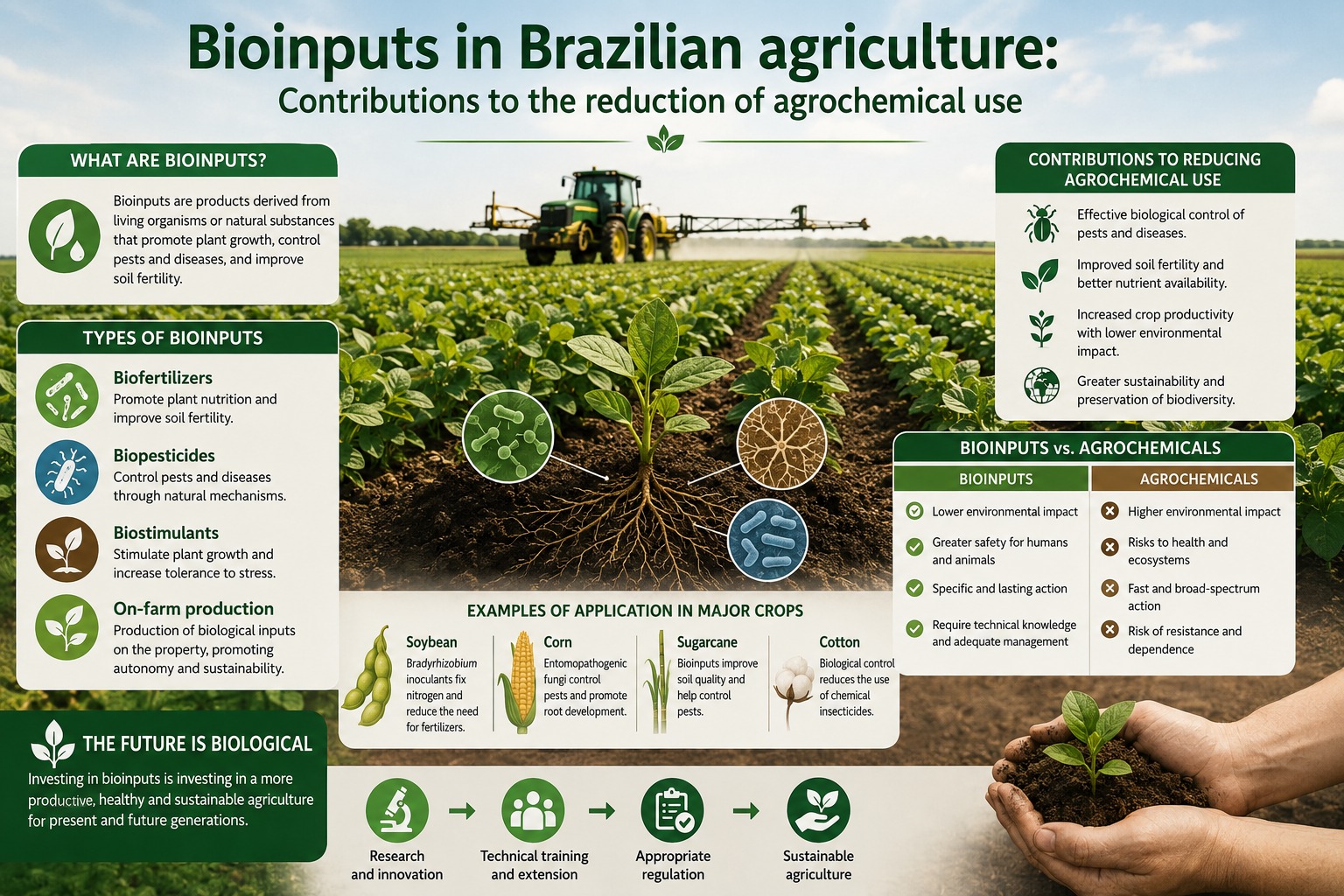
Modern agriculture faces the challenge of increasing the production of food, fiber, and biofuels while minimizing environmental impacts and preserving soil quality. In this context, bioinputs have emerged as a promising alternative for reducing dependence on agrochemicals in Brazilian agriculture. This study aimed to analyze the advancement of bioinputs in Brazil and their contribution to reducing the use of synthetic chemical inputs. Specifically, the study sought to identify the main types of bioinputs used in agriculture, describe their characteristics and applications, evaluate their advantages and limitations, and examine their development and the challenges associated with their large-scale adoption. The research was conducted through a qualitative and descriptive literature review, based on scientific articles, dissertations, theses, and institutional documents published between 2010 and 2026. The results revealed significant growth in the Brazilian bioinputs sector, with an estimated market value of approximately BRL 5 billion during the 2023/2024 crop season, representing a 15% increase compared to the previous season and an average annual growth rate of nearly 21% in recent years. Furthermore, the potential area treated with bioinputs exceeded 155 million hectares during the 2024/2025 crop season, highlighting their increasing incorporation into agricultural production systems. The reviewed literature indicates that inoculants, biological control agents, biofertilizers, and biostimulants contribute to the partial replacement of chemical fertilizers and pesticides, improving soil fertility, supporting integrated pest management, and enhancing agricultural sustainability. It is concluded that bioinputs represent a strategic technology for sustainable Brazilian agriculture, with substantial potential to reduce dependence on agrochemicals and mitigate environmental impacts, provided that their adoption is supported by continuous investments in research, innovation, technical assistance, and public policies that encourage their use.
References
Araujo, S. E. E. S., & Balsamo, R. Biossegurança aplicada à produção de bioinsumos: estratégia para redução do uso de insumos sintéticos. Repositório Institucional, 2(2), 2024.
Barbosa, M. F., Sales, R. M., Galarza, F. A., Kruger, C. Q., Fávaro, L. C. L., & Quirino, B. F. Biological resources driving productivity: bioinputs for sustainable plant agriculture in Brazil. Sustainable Microbiology, 2(3). https://doi.org/10.1093/sumbio/qvaf011
Basso, M. C. A. Biofertilizantes e biochar: impactos sustentáveis e políticas públicas para a agricultura brasileira. Caderno Pedagógico, 22(1), e13575-e13575, 2025.
Bavaresco, L. S.. Compreensão da percepção sobre bioinsumos no Brasil: uma análise exploratória, 2024.
Benaissa, A. Rhizosphere: Role of bacteria to manage plant diseases and sustainable agriculture – A review. Journal of Basic Microbiology, 64(3), 2300361, 2024. https://doi.org/10.1002/jobm.202300361
Beyari, E. A. Alternatives to chemical pesticides: the role of microbial biocontrol agents in phytopathogen management: a comprehensive review. Journal of Plant Pathology, 107, 291-314, 2024. https://doi.org/10.1007/s42161-024-01808-8
Bortoloti, G., & Sampaio, R. M. Desafios e estratégias no desenvolvimento dos bioinsumos para controle biológico no Brasil. Revista Tecnologia e Sociedade, 20(60), 291-307, 2024.
Bouri, M., Arslan, K. S., & Şahin, F. Climate-smart pest management in sustainable agriculture: Promises and challenges. Sustainability, 15(5), 4592, 2023. https://doi.org/10.3390/su15054592
Brasil. Brasília. Lei nº 7.802, de 11 de julho de 1989. Diário Oficial da República Federativa do Brasil, 2015. Available at: https://www.academia.edu/download/34453884/CLAUDIOSPAZ_LEISAMBIENTAISNOBRASIL.PDF. Accessed on: March 20, 2026.
Brunelle, T., Chakir, R., Carpentier, A., Dorin, B., Goll, D., Guilpart, N., Maggi F. Reducing chemical inputs in agriculture requires a system change. Communications Earth & Environment, 369, 2024. https://doi.org/10.1038/s43247-024-01533-1
Buss, W., Belt, K., Hein, Z., Putri, A., Zhu, S., Suwandari, H., & Bentley, A. R. Hurdles to overcome to achieve biostimulants-driven, low chemical input crop production. Plants People Planet, 8(3), 783-791, 2026. https://doi.org/10.1002/ppp3.70030
Corrêa, G. M., Pereira, C. S., Queiroz, A. T. S., Silva, M. P., Use of bioinputs in sustanaible agriculture: Trends, challenges and perspectives for reducing the use of agrochemicals. Revista de Gestão Social e Ambiental, 19(5), 1-21, 2025. https://doi.org/10.24857/rgsa.v19n5-003
Dmytruk, O., Yemets, A., & Dmytruk, K. Yeasts as biofertilizers and biocontrol agents: Mechanisms and applications. Biotechnology and Applied Biochemistry, 73(2), 964-976, 2025. https://doi.org/10.1002/bab.70029
Faria, M., Mascarin, G. M., Butt, T., & Lopes, R. B. On-farm production of microbial entomopathogens for use in agriculture: Brazil as a case study. Neotropical Entomology, 52, 122-133, 2023. https://doi.org/10.1007/s13744-023-01033-5
Faria, R. S., & Wander, A. E. Bio-Inputs in Brazilian Agriculture: Public Policies and Regulatory Framework. Revista de Gestão Social e Ambiental, 18(10), e09089, 2024. https://doi.org/10.24857/rgsa.v18n10-255
Förster, C. R-V. Bio-agricultural inputs: The coming revolution. Agricultural Engineering Today, 49(2), 13-14. http://dx.doi.org/10.52151/aet2025492.1826
García-Poza, S., Pacheco, D., Cotas, J., Marques, J. C., Pereira, L., Gonçalves, A. M. M. Marine macroalgae as a feasible and complete resource to address and promote sustainable development goals (SDGs). Integrated Environmental Assessment and Management, 18(5), 1148-1161, 2022. https://doi.org/10.1002/ieam.4598
Gil, A. C. Métodos e técnicas de pesquisa social. 7. ed. São Paulo: Atlas, 2019.
Goulet, F. On-farm agricultural inputs and changing boundaries: innovations around production of microorganisms in Brazil. Journal of Rural Studies, 101, 2023. https://doi.org/10.1016/j.jrurstud.2023.103070
Hemathilake, D. M. K. S., & Gunathilake, D. M. C. C. Agricultural productivity and food supply to meet increased demands. Future Foods, Chapter 31, Academic Press, 539-553, 2022. https://doi.org/10.1016/B978-0-323-91001-9.00016-5
Khatri, P., Kumar, P., Shakya, K. S., Kirlas, M. C., & Tiwari, K. K. Understanding the intertwined nature of rising multiple risks in modern agriculture and food system. Environment, Development and Sustainability, 26, 24107-24150. https://doi.org/10.1007/s10668-023-03638-7
Li, C., & Wang, M. Pest and disease management in agricultural production with artificial intelligence: Innovative applications and development trends. Advances in Resources Research, 4(3), 2024. https://doi.org/10.50908/arr.4.3_381
Liu, Y., Yang, Y., & Wang, B. Entomopathogenic fungi Beauveria bassiana and Metarhizium anisopliae play roles of maize (Zea mays) growth promoter. Scientific Reports, 12, 2022. https://doi.org/10.1038/s41598-022-19899-7
Maurya, R. P., Koranga, R., Samal, I., Chaudhary, D., Paschapur, A. U., Sreedhar, M., & Manimala, R. N. Biological control: a global perspective. International Journal of Tropical Insect Science, 42, 3203-3220, 2022. https://doi.org/10.1007/s42690-022-00881-9
Medina, G. S., & Cunha, N. B. Industrial bio-inputs for commodity farming: An ongoing revolution in Brazil’s agriculture. Commodities, 4(4), 26. https://doi.org/10.3390/commodities4040026
Medina, G. S., Nascimento, L. C., Stadnik, M. J., & Ramos, M. L. G. Innovative farming technique: The use of agricultural bio-inputs by soybean farmers in Brazil. AgriEngineering, 7(12), 416. https://doi.org/10.3390/agriengineering7120416
Priya, A. K., Alagumalai, A., Balaji, D., & Song, H. Bio-based agricultural products: a sustainable alternative to agrochemicals for promoting a circular economy. RSC Sustainability, 1, 746-762, 2023. https://doi.org/10.1039/D3SU00075C
Reuters. Brazil's bioinputs market boasts four times global average growth, research shows. 2024. Available at: https://www.reuters.com/markets/commodities/brazils-bioinputs-market-boasts-four-times-global-average-growth-research-shows-2024-06-25/?utm_source=chatgpt.com. Accessed on: May 04, 2026.
Rocha, T. M., Marcelino, P. R. F., Costa, R. A. M., Rubio-Ribeaux, D., Barbosa, F. G., & Silva, S. S. Agricultural bioinputs obtained by solid-state fermentation: From production in biorefineries to sustainable agriculture. Sustainability, 16(3), 1076. https://doi.org/10.3390/su16031076
Rosales-Castillo, R., Lucio, B. S. V., Hernández-Domínguez, E. M., & Álvarez-Cervantes, J. Bio-inputs: An alternative to achieve sustainable agriculture. Terra Latinoamericana, 43. https://doi.org/10.28940/terra.v43i.2045
Shahwar, D., Mushtaq, Z., Mushtaq, H., Park, Y., Alshahrani, T. S., & Faizan, S. Role of microbial inoculants as bio fertilizers for improving crop productivity: A review. Heliyon, 9(6), e16134, 2023. https://doi.org/10.1016/j.heliyon.2023.e16134
Shuchithkumar, C., Reddy, S., Divyavani, P., Sravya, M., Mani, M., & Manoharan, G. Modern challenges in agriculture. AIP Conference Proceedings, 2971(1), 2024. https://doi.org/10.1063/5.0195744
Silva, J. M., Dalbon, V. A., Alves, A. C., Ataíde, C. B., Santos, T. M. C., Costa, M. E. L., & Montaldo, Y. C. Bioinputs in sustainable agriculture: Benefits, challenges, and pathways for resilient farming systems. Asian Journal of Research in Crop Science, 10(2), 85-97, 2025. https://doi.org/10.9734/ajrcs/2025/v10i2354
Tomar, P., Thakur, N., Jhamta, S., Rai, P. K., Rai, A. K., Yadav, A. N., Rustagi, S., Rai, P. K., Rai, A. K., & Yadav, A. N. Bacterial biopesticides: Biodiversity, role in pest management and beneficial impact on agricultural and environmental sustainability. Heliyon, 2024.
Ulrich, K. The substitute and the excuse: Growing sustainability, growing sugarcane in São Paulo, Brazil. Cultural Anthropology, 38(4). https://doi.org/10.14506/ca38.4.01
Valente, I. L., Wancura, J. H., Zabot, G. L., & Mazutti, M. A. Endophytic and Rhizospheric microorganisms: An alternative for sustainable, organic, and regenerative bioinputs formulations for modern agriculture. Microorganisms, 13(4), 813. https://doi.org/10.3390/microorganisms13040813
Vaz, A. P. A., Silva, V. Q. R., Faria, M. R., Halfeld-Vieira, B. A., Baizi e Silva, A. R. Bioinputs and bioenergy: research’s contributions to Brazil’s transition to a green economy. Pesquisa Agropecuária Brasileira, 60, e04147, 2025. https://doi/org/10.1590/S1678-3921.pab2025.v60.04147
Vermelho, A. B., Moreira, J. V., Akamine, I. T., Cardoso, V. S., & Mansoldo, F. R. P. Agricultural pest management: The role of microorganisms in biopesticides and soil bioremediation. Plants, 13(19), 2762, 2024. https://doi.org/10.3390/plants13192762
Downloads
Published
How to Cite
Issue
Section
License
Copyright (c) 2026 Alex Silva do Carmo, Francisco Rafael Santos da Conceição, Hellen Regina Fernandes Batista Ventura

This work is licensed under a Creative Commons Attribution 4.0 International License.
Authors who publish with this journal agree to the following terms:
1) Authors retain copyright and grant the journal right of first publication with the work simultaneously licensed under a Creative Commons Attribution License that allows others to share the work with an acknowledgement of the work's authorship and initial publication in this journal.
2) Authors are able to enter into separate, additional contractual arrangements for the non-exclusive distribution of the journal's published version of the work (e.g., post it to an institutional repository or publish it in a book), with an acknowledgement of its initial publication in this journal.
3) Authors are permitted and encouraged to post their work online (e.g., in institutional repositories or on their website) prior to and during the submission process, as it can lead to productive exchanges, as well as earlier and greater citation of published work.