Germination and vigor of two varieties of Jiló (Solanum gilo Raddi) under different substrates and pH conditions
DOI:
https://doi.org/10.14295/cerrado.v3i2.896Keywords:
Solanum gilo, physiological quality, early development, agricultural substrates, seedling production, vegetable cropsAbstract
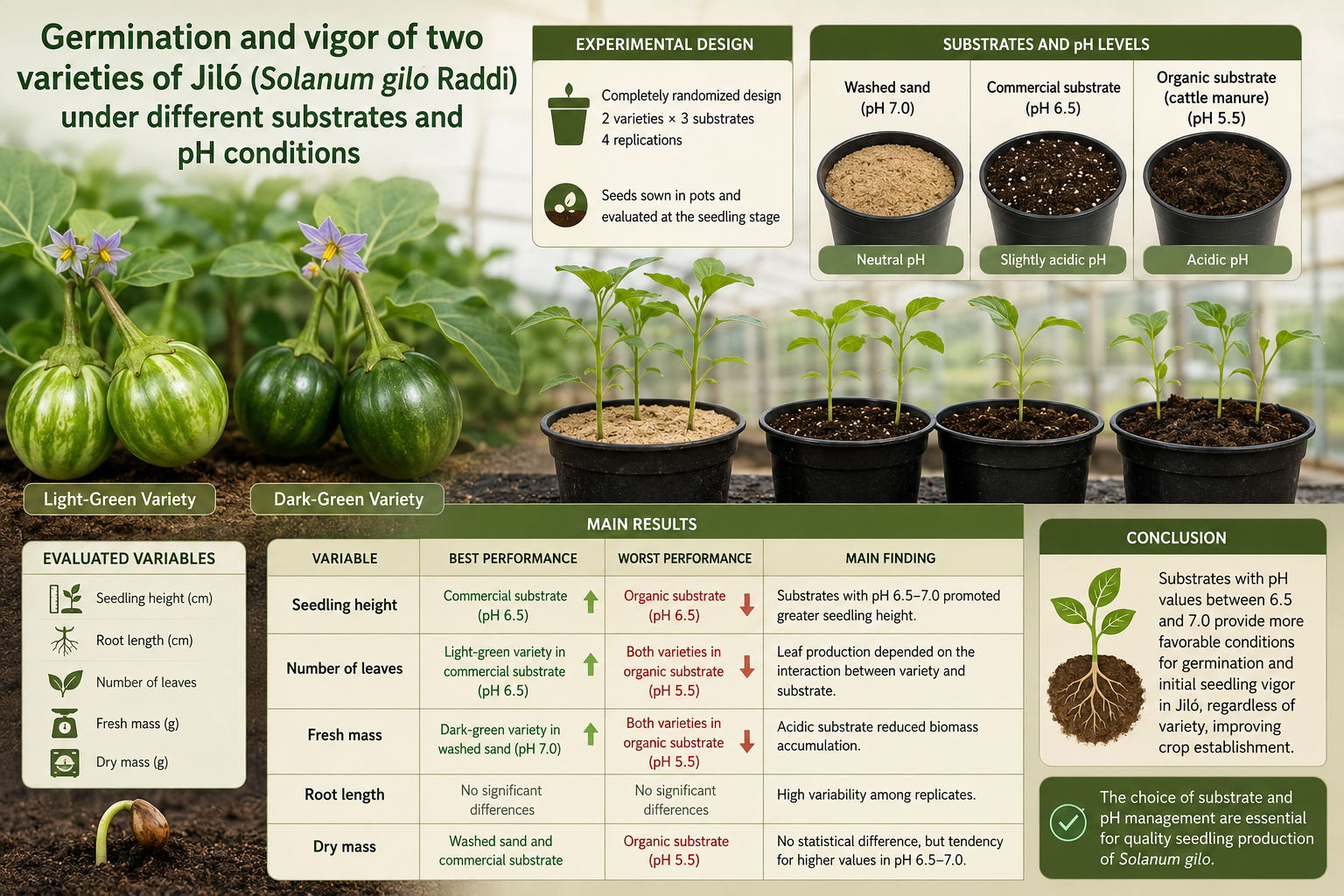
Jiló (Solanum gilo Raddi) is a vegetable crop widely cultivated in Brazil, particularly by smallholder farmers, and plays an important economic and nutritional role in several regions of the country. However, information regarding the influence of different substrates and pH conditions on seed germination and seedling vigor remains limited. Therefore, this study aimed to evaluate the germination and vigor of two commercial Jiló varieties, light-green and dark-green, grown in substrates with different pH levels. The experiment was conducted in a completely randomized design using a 2 × 3 factorial arrangement (two varieties × three substrates), with four replications. The treatments consisted of washed sand (pH 7.0), commercial substrate (pH 6.5), and an organic substrate based on cattle manure (pH 5.5). The evaluated variables were seedling height, root length, number of leaves, fresh mass, and dry mass. Data were subjected to analysis of variance (ANOVA), and means were compared using Tukey’s test at the 5% significance level. Substrate effects were significant for seedling height, number of leaves, and fresh mass, whereas varietal effects were observed only for the number of leaves. The commercial substrate (pH 6.5) promoted the highest number of leaves in the light-green variety, while the dark-green variety grown in washed sand exhibited the highest fresh mass. In contrast, the organic substrate at pH 5.5 yielded the lowest values for most traits evaluated, indicating a negative effect of higher acidity on early seedling development. It is concluded that substrates with pH values ranging from 6.5 to 7.0 provide more favorable conditions for germination and initial seedling vigor in Jiló, regardless of variety, thereby improving crop establishment.
References
Alvarez, V. H., Novais, R. F., Barros, N. F., Cantarutti, R. B., & Lopes, A. S. (1999). Interpretação dos resultados das análises de solos. In: Ribeiro, A. C. et al. Recomendações para o uso de corretivos e fertilizantes em Minas Gerais – 5ª Aproximação. Viçosa: CFSEMG.
Bewley, J. D., Bradford, K. J., Hilhorst, H. W. M., & Nonogaki, H. (2013). Seeds: Physiology of Development, Germination and Dormancy. 3rd ed. New York: Springer. https://doi.org/10.1007/978-1-4614-4693-4
Ferrarezi, R. S., Qin, K., Nguyen, L. X., Poole, D., Cárdenas-Gallegos, J. S., Oliveira, H. F. E., & Housley, M. J. (2024). Multi-season evaluation of substrates for optimized Arugula and lettuce production in hydroponics. HortScience, 59(3), 403-411. https://doi.org/10.21273/HORTSCI17606-23
Follmer, C. M., Hummes, A. P., Lângaro, N. C., Petry, C., Moterle, D. F., & Bortoluzzi, E. C. (2021). Nutrient availability and pH level affect germination traits and seedling development of Conyza canadensis. Scientific Reports, 11, 15607. https://doi.org/10.1038/s41598-021-95164-7
Lynch, J. P. (2019). Root phenotypes for improved nutrient capture: an underexploited opportunity for global agriculture. New Phytologist, 223(2), 548-564. https://doi.org/10.1111/nph.15738
Marcos Filho, J. (2015). Fisiologia de sementes de plantas cultivadas. Londrina: ABRATES.
Metwally, R. A., Abdelhameed, R. E., Soliman, S. A., & Al-Badwy, A. (2022). Potential use of beneficial fungal microorganisms and C-phycocyanin extract for enhancing seed germination, seedling growth and biochemical traits of Solanum lycopersicum L. BMC Microbiology, 22. https://doi.org/10.1186/s12866-022-02509-x
Msimbira, L. A., Naamala, J., Antar, M., Subramanian, S., & Smith, D. L. (2022). Effect of microbial cell-free supernatants extracted from a range of pH levels on corn (Zea mays L.) and tomato (Solanum lycopersicum L.) seed germination and seedling growth. Frontiers in Sustainable Food Systems, 6, 789335. https://doi.org/10.3389/fsufs.2022.789335
Taiz, L., Zeiger, E., Møller, I. M., & Murphy, A. (2017). Plant Physiology and Development. 6th ed. Sunderland: Sinauer Associates.
Trejo-Téllez, L. I., Gómez-Merino, F. C., García-Albarado, J. C., & Peralta-Sánchez, M. G. (2022). Organic substrates differentially affect growth and macronutrient concentrations of Solanum quitoense seedlings. Horticulturae, 8(12), 1200. https://doi.org/10.3390/horticulturae8121200
Villarreal-Sánchez, J. A., Díaz-Jiménez, L., Escobedo-Bocardo, J. C., Cardenas-Palomo, J. O., Luna-Alvarez, J. S., & Carlos-Hernández, S. (2022). Effect of clay and guishe-ash as substrate on Lycopersicon esculentum germination and production. International Journal of Phytoremediation, 24(12), 1330-1338. https://doi.org/10.1080/15226514.2021.2025209
Downloads
Published
How to Cite
Issue
Section
License
Copyright (c) 2026 Selismar Martins de Souza, Elizabete Nunes da Rocha

This work is licensed under a Creative Commons Attribution 4.0 International License.
Authors who publish with this journal agree to the following terms:
1) Authors retain copyright and grant the journal right of first publication with the work simultaneously licensed under a Creative Commons Attribution License that allows others to share the work with an acknowledgement of the work's authorship and initial publication in this journal.
2) Authors are able to enter into separate, additional contractual arrangements for the non-exclusive distribution of the journal's published version of the work (e.g., post it to an institutional repository or publish it in a book), with an acknowledgement of its initial publication in this journal.
3) Authors are permitted and encouraged to post their work online (e.g., in institutional repositories or on their website) prior to and during the submission process, as it can lead to productive exchanges, as well as earlier and greater citation of published work.