Evaluation of different fertilization sources in lettuce (Lactuca sativa L.) cultivation
DOI:
https://doi.org/10.14295/cerrado.v3i2.892Keywords:
Lactuca genus, Chemical fertilization, Cattle manure, Foliar fertilization, Vegetable production, Plant biomassAbstract
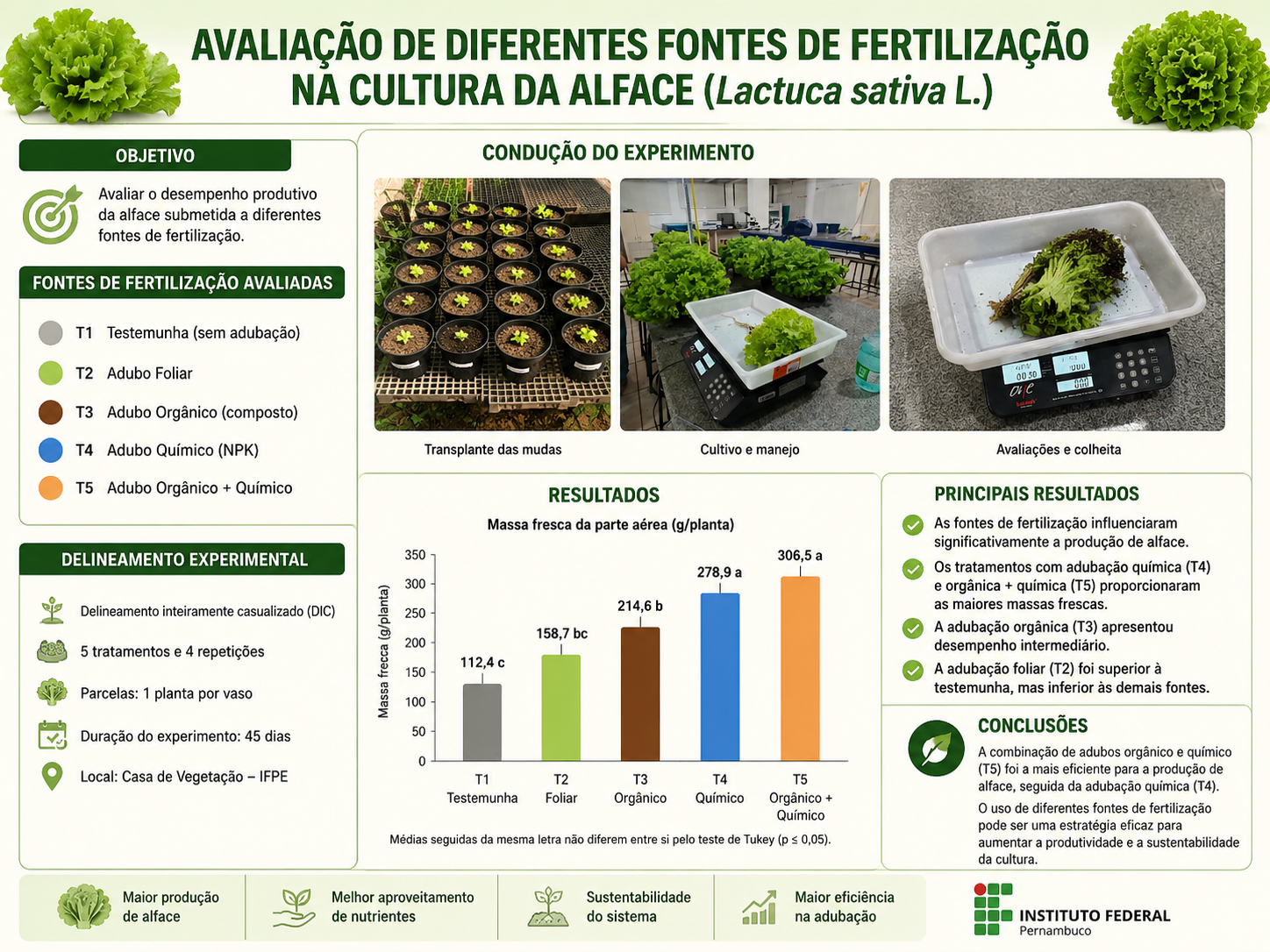
Lettuce (Lactuca sativa L.) is one of the most economically important leafy vegetables cultivated in Brazil, and the choice of fertilization source directly influences its growth and productivity. This study aimed to evaluate the effects of four fertilization treatments—control (without fertilization), organic fertilization (30% composted cattle manure by substrate volume), foliar fertilization (NPK 20–20–20 supplemented with micronutrients at 2 g L-1, applied biweekly), and chemical fertilization (NPK 04–14–08 at 100 g m-2)—on the growth performance of lettuce cultivated in pots under greenhouse conditions. The experiment was conducted in a completely randomized design with four treatments and six replications, totaling 24 experimental units. At 45 days after transplanting, the following variables were evaluated: plant height (PH), number of leaves (NL), shoot fresh mass (SFM), shoot dry mass (SDM), and root system length (RSL). Data were subjected to analysis of variance (ANOVA), and treatment means were compared using Tukey’s test at the 5% significance level in the R statistical software. Chemical fertilization resulted in the highest values for PH (22.83 cm), NL (33.17 leaves), SFM (415.33 g), and SDM (24.33 g), differing significantly from the other treatments for most evaluated variables. Organic fertilization showed intermediate performance but exhibited considerable variability among replicates (coefficient of variation up to 67.6% for SFM), likely associated with differences in manure decomposition and nutrient availability. Foliar fertilization alone did not significantly differ from the control treatment for any biomass-related variable. Regarding RSL, the control treatment produced the longest roots (30.83 cm), significantly exceeding those observed under chemical fertilization (19.00 cm), indicating root plasticity in response to nutrient availability. The results demonstrate that chemical fertilization with NPK 04–14–08 promotes superior shoot biomass production during short lettuce production cycles, whereas organic fertilization may represent a viable alternative when high-quality and homogeneous organic inputs are available.
References
Balkrishna, A., Gautam, A. K., Sharma, N., Khelwade, V. Effects of organic and bio-fertilizers on growth and yield performance of leafy vegetables. Journal of Wastes and Biomass Management, 7(1), 01-07, 2025. https://doi.org/10.26480/jwbm.01.2025.22.28
Cecílio Filho, A. B., Bonela, G. D., Cruz, M. C. P., Mendoza-Cortez, J. W., & Toscano, C. R. P. Potassium fertilization of lettuce in potassium-rich Eutrudox soil. African Journal Agriculture Research, v.10, p.194-199, 2015.
Cardoso, F. L., Andriolo, J. L., Dal Picio, M., Piccin, M., & Souza, J. M. Nitrogen on growth and yield of lettuce plants grown under root confinement. Horticulture Brasileira, 33, 422-427, 2015. http://dx.doi.org/10.1590/S0102-053620150000400003
Embrapa Hortaliças. Sistema de produção de alface para agricultura familiar e agronegócio. Brasília: Embrapa, 2014. (Embrapa Hortaliças.) Sistema de Produção, 4). https://sistemasdeproducao.cnptia.embrapa.br/FontesHTML/Alface/
Ferreira, D. F. SISVAR: A computer statistical analysis system. Ciência e Agrotecnologia, 35(6), 1039-1042, 2011. https://doi.org/10.1590/S1413-70542011000600001
Filgueira, F. A. R. Novo manual de olericultura: agrotecnologia moderna na produção e comercialização de hortaliças. 3. ed. Viçosa: UFV, 421, 2008.
Foteinis, S., & Chatzisymeon, E. Life cycle assessment of organic versus conventional agriculture. A case study of lettuce cultivation in Greece. Journal of Cleaner Production, 112(4), 2462-2471, 2016.
IBGE – Instituto Brasileiro de Geografia e Estatística. Produção agrícola municipal. Rio de Janeiro: IBGE, 2023. Disponível em: https://www.ibge.gov.br/estatisticas/economicas/agricultura-e-pecuaria/9117-producao-agricola-municipal.html
Kano, C., Cardoso, A. I. I., Villas BÔAS, R. L. Phosphorus rates on yield and quality of lettuce seeds. Horticultura Brasileira, 30, 695-698, 2012.
Li, Q., Xu, M., Xu, L., Wu, X., Zhang, Y., Xin, J., Shen, Y., & Gao, J. Organic fertilization leads to N limitation rather than P limitation in both vegetable soils. Agronomy, 15(1), 190. https://doi.org/10.3390/agronomy15010190
Malavolta, E., Vitti, G. C., & Oliveira, S. A. Avaliação do estado nutricional das plantas: princípios e aplicações. 2. ed. Piracicaba: Potafos, 319. 1997.
Marschner, H., Kirby, E. A., & Cakmak, I. Effect of mineral nutritional status on shoot-root partitioning of photoassimilates and cycling of mineral nutrients. Journal of Experimental Botany, 47, 1255-1263, 1996. https://doi.org/10.1093/jxb/47.Special_Issue.1255
Luz, J. M. Q., Oliveira, G., Queiroz, A. A., & Carreon, R. Aplicação foliar de fertilizantes organominerais em cultura de alface. Horticultura Brasileira, 28(3), 373-377, 2010. https://doi.org/10.1590/S0102-05362010000300023
Lynch, J. P. Root phenotypes for improved nutrient capture: an underexploited opportunity for global agriculture. New Phytologist, 223(2), 548-564, 2019.
Ohse, S., Dourado Neto, D., Manfron, P. A., & Santos, O. S. Qualidade de cultivares de alface produzidos em hidroponia. Scientia Agrícola, 58(1), 181-185, 2001. DOI:10.1590/S0103-90162001000100028
Raij, B., Cantarella, H., Quaggio, J. A., & Furlani, A. M. C. (ed.). Recomendações de adubação e calagem para o Estado de São Paulo. 2. ed. Campinas: Instituto Agronômico & Fundação IAC. Boletim Técnico, 100. 285, 1997.
Rodrigues, E. T., & Casali, V. W. D. Rendimento e concentração de nutrientes em alface, em função das adubações orgânica e mineral. Horticultura Brasileira, 17(2), 125-128, 1999.
Sampaio, F. A. R., Teixeira Filho, M. C. M., Oliveira, C. E. S., Boleta, E. H. M., Lima, B. H., Rosa, P. A. L., Galindo, F. S., & Souza, J. S. Nitrogen supply associated with rhizobacteria in the first productive cycle of Marandu grass. Journal of Crop Science and Biotechnology, 24, 429-439, 2021. https://doi.org/10.1007/s12892-021-00091-8
Sediyama, M. A. N., Santos, I. C., & Lima, P. C. Cultivo de hortaliças no sistema orgânico. Revista Ceres, 61, 829-837, 2014. http://dx.doi.org/10.1590/0034-737X201461000008
Ssemugenze, B., Ocwa, A., Kuunya, R., Gumisiriya, C., Bojtor, C., Nagy, J., Széles, A., & Illés, Á. Enhancing maize production through timely nutrient supply: The role of foliar fertiliser application. Agronomy, 15(1), 176. https://doi.org/10.3390/agronomy15010176
Silva, A. F. T., Avelino, R. C., Brito, L. P. S., Anjos, J. C. R., Júnior, J. V. S., & Beckmann-Cavalcante, M. Z. Growth and yield of lettuce cultivars under organic fertilization and different environments. Comunicata Scientiae, 8(2), 8(2), 264-274, 2017. https://doi.org/10.14295/cs.v8i2.2167
Taiz, L., Zeiger, E., Moller, I. M., & Murphy, A. Plant Physiology and Development. 6. ed. Sunderland: Sinauer Associates, 2017.
Trani, P. E., Terra, M. M., Tecchio, M. A., Telles, T. S., & Hanasiro, J. Adubação orgânica de hortaliças e fruteiras. Boletim Técnico IAC, 222. Campinas: Instituto Agronômico, 36, 2013.
Downloads
Published
How to Cite
Issue
Section
License
Copyright (c) 2026 Everton de Araújo Arantes, Sabrina Santiago de Moraes, Elizabete Nunes da Rocha

This work is licensed under a Creative Commons Attribution 4.0 International License.
Authors who publish with this journal agree to the following terms:
1) Authors retain copyright and grant the journal right of first publication with the work simultaneously licensed under a Creative Commons Attribution License that allows others to share the work with an acknowledgement of the work's authorship and initial publication in this journal.
2) Authors are able to enter into separate, additional contractual arrangements for the non-exclusive distribution of the journal's published version of the work (e.g., post it to an institutional repository or publish it in a book), with an acknowledgement of its initial publication in this journal.
3) Authors are permitted and encouraged to post their work online (e.g., in institutional repositories or on their website) prior to and during the submission process, as it can lead to productive exchanges, as well as earlier and greater citation of published work.