Arbuscular mycorrhizal fungi and plant resilience in the face of climate change: ecological and physiological mechanisms and sustainable applications
DOI:
https://doi.org/10.14295/cerrado.v3i3.886Keywords:
Abiotic stres, Climate adaptation, Mycorrhizal symbiosis, Soil sustainability, Ecosystem resilience, Plant–fungus interactionsAbstract
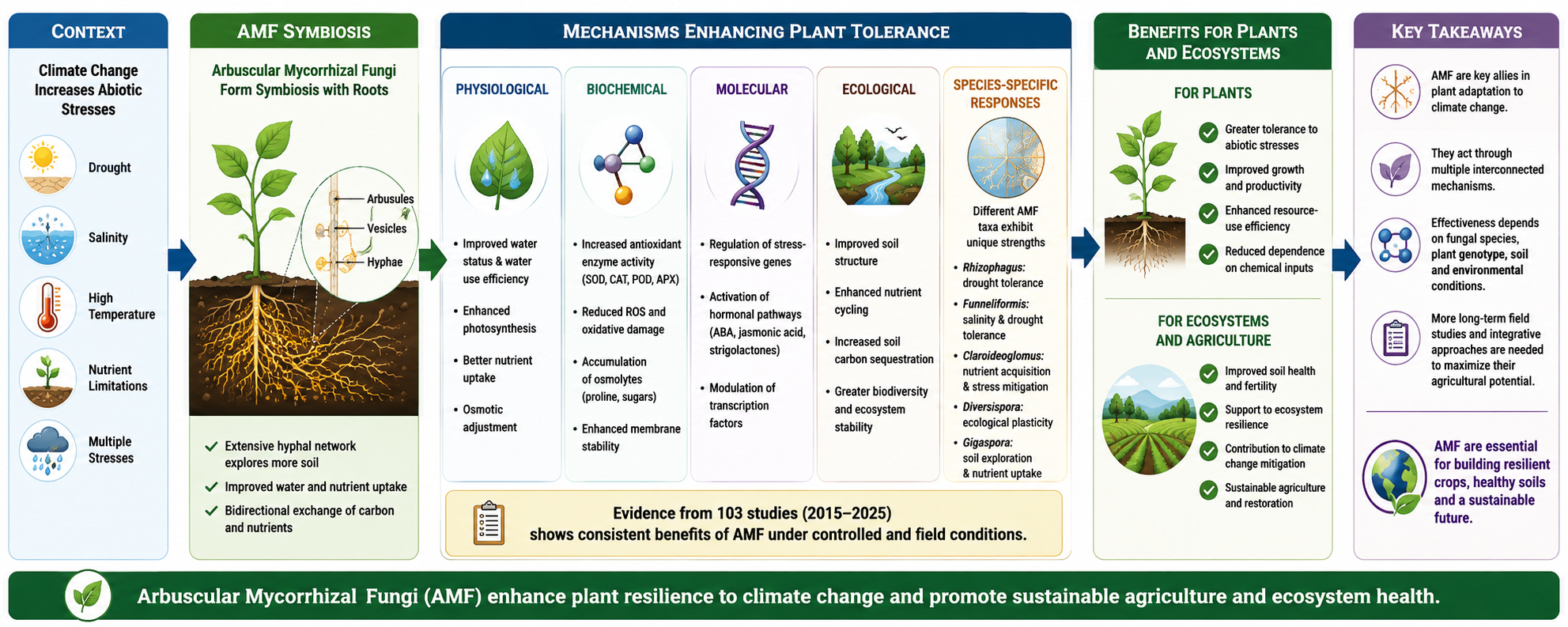
Climate change has intensified environmental stresses such as drought, salinity, nutrient limitations, and extreme temperatures, threatening plant productivity and ecosystem stability worldwide. This systematic review aimed to synthesize current scientific evidence regarding the role of arbuscular mycorrhizal fungi (AMF) in enhancing plant resilience to climate change-related stresses. A systematic literature review was conducted following PRISMA guidelines, including studies published between 2001 and 2026, retrieved from major scientific databases. A total of 43 eligible studies were analyzed. The results demonstrated that AMF significantly improve plant tolerance to drought, salinity, and multiple simultaneous stressors through enhanced water and nutrient acquisition, increased photosynthetic efficiency, activation of antioxidant defense systems, osmotic adjustment, hormonal regulation, and modulation of stress-responsive genes. In addition, AMF contribute to soil aggregation, nutrient cycling, carbon sequestration, and ecosystem stability, supporting sustainable agricultural practices and ecological restoration initiatives. The findings highlight that AMF-mediated resilience results from integrated physiological, biochemical, molecular, and ecological mechanisms operating across multiple biological scales. Therefore, arbuscular mycorrhizal fungi represent a promising biological resource for climate adaptation, sustainable land management, and the development of more resilient agricultural and natural ecosystems.
References
Auge, R. M. Water relations, drought and vesicular-arbuscular mycorrhizal symbiosis. Mycorrhiza, 11, 3-42, 2001. DOI: 10.1007/s005720100097.
Bennett, A. E., & Classen, A. T. Climate change influences mycorrhizal fungal-plant interactions, but conclusions are limited by geographical study bias. Ecology, 101(4), e02978, 2020. DOI: 10.1002/ecy.2978.
Begum, N., Qin, C., Ahanger, M. A., Raza, S., Khan, M. I., Ashraf, M., Ahmed, N., & Zhang, L. Role of arbuscular mycorrhizal fungi in plant growth regulation: Implications in abiotic stress tolerance. Frontiers in Plant Science, 10, 1068, 2019. DOI: 10.3389/fpls.2019.01068.
Berruti, A., Lumini, E., Balestrini, R., & Bianciotto, V. Arbuscular mycorrhizal fungi as natural biofertilizers: Let’s benefit from past successes. Frontiers in Microbiology, 6, 1559, 2016. DOI: 10.3389/fmicb.2015.01559.
Boorboori, M. R., & Lackóová, L. Arbuscular mycorrhizal fungi and salinity stress mitigation in plants. Frontiers in Plant Science, 15, 1504970, 2025. DOI: 10.3389/fpls.2024.1504970.
Cardoso Filho, J., Ramos, R., & Pascholati, S. F. Arbuscular mycorrhizal symbiosis and its role in plant nutrition in sustainable agriculture. In: Agriculturally important microbes for sustainable agriculture, 129-164, 2017. DOI: 10.1007/978-981-10-5343-6_5.
Chanda, A., Hamed, H., Sayour, H., Gummadidala, P., & Gomaa, O. Impact of climate change on plant-associated fungi. In: Climate change and microbial diversity, 2020. DOI: 10.1007/978-3-030-41629-4_5.
Chandrasekaran, M. Arbuscular mycorrhizal fungi mediated alleviation of drought stress via non-enzymatic antioxidants: A meta-analysis. Plants, 11(19), 2448, 2022a. DOI: 10.3390/plants11192448.
Chandrasekaran, M. Arbuscular mycorrhizal fungi mediated enhanced biomass, root morphological traits and nutrient uptake under drought stress: A meta-analysis. Journal of Fungi, 8(7), 660, 2022b. DOI: 10.3390/jof8070660.
Chen, M., Arato, M., Borghi, L., Nouri, E., & Reinhardt, D. Beneficial services of arbuscular mycorrhizal fungi – from ecology to application. Frontiers in Plant Science, 9, 1270, 2018. DOI: 10.3389/fpls.2018.01270.
Cheng, S., Zou, Y. N., Kuča, K., Hashem, A., Abd Allah, E. F., & Wu, Q. S. Elucidating the mechanisms underlying enhanced drought tolerance in plants mediated by arbuscular mycorrhizal fungi. Frontiers in Microbiology, 12, 809473, 2021. DOI: 10.3389/fmicb.2021.809473.
Choudhary, Y., Mathur, S., & Jajoo, A. Beneficial networking between AMF and plants leads to improved stress tolerance. Discover Plants, 3, 30, 2026. DOI: 10.1007/s44372-026-00494-3.
Conti, G., Urcelay, C., Gundel, P. E., & Piñeiro, G. The potential of arbuscular mycorrhizal fungi to improve soil organic carbon in agricultural ecosystems: A meta-analytical approach. Functional Ecology, 39, 1016–1030, 2025. DOI: 10.1111/1365-2435.14753.
Das, S., & Sarkar, S. Arbuscular mycorrhizal fungal contribution towards plant resilience to drought conditions. Frontiers in Fungal Biology, 5, 1355999, 2024. DOI: 10.3389/ffunb.2024.1355999.
Dastogeer, K. M. G., Zahan, M. I., Tahjib-Ul-Arif, M., Akter, M. A., & Okazaki, S. Plant salinity tolerance conferred by arbuscular mycorrhizal fungi and associated mechanisms: A meta-analysis. Frontiers in Plant Science, 11, 588550, 2020. DOI: 10.3389/fpls.2020.588550.
Diagne, N., Ngom, M., Djighaly, P. I., Fall, D., Hocher, V., & Svistoonoff, S. Roles of arbuscular mycorrhizal fungi on plant growth and performance: Importance in biotic and abiotic stressed regulation. Diversity, 12, 370, 2020. DOI: 10.3390/d12100370.
Duarte, A. G., & Maherali, H. A meta-analysis of the effects of climate change on the mutualism between plants and arbuscular mycorrhizal fungi. Ecology and Evolution, 12(1), e8518, 2022. DOI: 10.1002/ece3.8518.
Duc, N. H., Csintalan, Z., & Posta, K. Arbuscular mycorrhizal fungi mitigate negative effects of combined drought and heat stress on tomato plants. Plant Physiology and Biochemistry, 132, 297–307, 2018. DOI: 10.1016/j.plaphy.2018.09.011.
Etesami, H., Otabek, U., Zahro, B., Laziz, Y., & Sevara, N. Arbuscular mycorrhizal fungi in desert ecosystems: Adaptive mechanisms to co-occurring drought, temperature, and salinity stress. Fungal Biology Reviews, 55, 100472, 2026. DOI: 10.1016/j.fbr.2026.100472.
Evelin, H., Devi, T. S., Gupta, S., & Kapoor, R. Mitigation of salinity stress in plants by arbuscular mycorrhizal symbiosis: Current understanding and new challenges. Frontiers in Plant Science, 10, 470, 2019. DOI: 10.3389/fpls.2019.00470.
Feng, Z., Liu, X., Zhu, H., & Yao, Q. Responses of arbuscular mycorrhizal symbiosis to abiotic stress: A lipid-centric perspective. Frontiers in Plant Science, 11, 578919, 2020. DOI: 10.3389/fpls.2020.578919.
Formenti, C., Mauromicale, G., Pandino, G., & Lombardo, S. Arbuscular mycorrhizal fungi mitigate crop multi-stresses under mediterranean climate: A systematic review. Agronomy, 16, 113, 2026. DOI: 10.3390/agronomy16010113.
Hashem, A., Kumar, A., Al-Dbass, A. M., Alqarawi, A. A., Al-Arjani, A. F., Singh, G., Farooq, M., & Abd Allah, E. F. Arbuscular mycorrhizal fungi and biochar improves drought tolerance in chickpea. Saudi Journal of Biological Sciences, 26(3), 614–624, 2019. DOI: 10.1016/j.sjbs.2018.11.005.
Hussain, H. A., Liang, Z., Hussain, S., Luo, J., Sui, S., & Liu, D. Harnessing arbuscular mycorrhizal symbiosis to enhance growth and resilience to combined drought and heat stress in lily (Lilium spp.). Plants, 15(5), 767, 2026. DOI: 10.3390/plants15050767.
Jajoo, A., & Mathur, S. Role of arbuscular mycorrhizal fungi as an underground saviour for protecting plants from abiotic stresses. Physiology and Molecular Biology of Plants, 27, 2589–2603, 2021. DOI: 10.1007/s12298-021-01091-2.
Jenab, K., Alteio, L., Guseva, K., et al. Arbuscular mycorrhizal fungal families and exploration-based guilds exhibit distinct responses to long-term N, P and K deficiencies and imbalances. New Phytologist, 250, 1846–1862, 2026. DOI: 10.1111/nph.70969.
Kumar, A., Kumar, R., Singh, P., et al. Emerging role of arbuscular mycorrhizal fungi in sustainable agriculture: From biology to field application. MicrobiologyOpen, 14(5), e70082, 2025. DOI: 10.1002/mbo3.70082.
Latef, A. A. H. A., Hashem, A., Rasool, S., Abd Allah, E. F., Egamberdieva, D., Jan, S., Anjum, N. A., & Ahmad, P. Arbuscular mycorrhizal symbiosis and abiotic stress in plants: A review. Journal of Plant Biology, 59, 407–426, 2016. DOI: 10.1007/s12374-016-0237-7.
Lenoir, I., Fontaine, J., & Lounès-Hadj Sahraoui, A. Arbuscular mycorrhizal fungal responses to abiotic stresses: A review. Phytochemistry, 123, 4-15, 2016. DOI: 10.1016/j.phytochem.2016.01.002.
Madouh, T. A., & Quoreshi, A. M. The Function of Arbuscular Mycorrhizal Fungi Associated with Drought Stress Resistance in Native Plants of Arid Desert Ecosystems: A Review. Diversity, 15(3), 391, 2023. DOI: 10.3390/d15030391.
Millar, N. S., & Bennett, A. E. Stressed out symbiotes: hypotheses for the influence of abiotic stress on arbuscular mycorrhizal fungi. Oecologia, 182, 625-641, 2016. DOI: 10.1007/s00442-016-3673-7.
Nadeem, S. M., Ahmad, M., Zahir, Z. A., Javaid, A., & Ashraf, M. The role of mycorrhizae and plant growth promoting rhizobacteria (PGPR) in improving crop productivity under stressful environments. Biotechnology Advances, 32, 429–448, 2014. DOI: 10.1016/j.biotechadv.2013.12.005.
Nie, W., He, Q., Guo, H., Zhang, W., Ma, L., Li, J., & Wen, D. Arbuscular mycorrhizal fungi: Boosting crop resilience to environmental stresses. Microorganisms, 12(12), 2448, 2024. DOI: 10.3390/microorganisms12122448.
Page, M. J., McKenzie, J. E., Bossuyt, P. M., et al. The PRISMA 2020 statement: an updated guideline for reporting systematic reviews. BMJ, 372, n71, 2021. DOI: 10.1136/bmj.n71.
Ruiz-Lozano, J. M., Aroca, R., Zamarreño, Á. M., et al. Arbuscular mycorrhizal symbiosis induces strigolactone biosynthesis under drought and improves drought tolerance in lettuce and tomato. Plant, Cell and Environment, 39, 441–452, 2016. DOI: 10.1111/pce.12631.
Samanta, I., Ghosh, K., Saikia, R., Savita, Maity, P. J., & Chowdhary, G. Arbuscular mycorrhizal fungi – a natural tool to impart abiotic stress tolerance in plants. Plant Signaling and Behavior, 20(1), 2525843, 2025. DOI: 10.1080/15592324.2025.2525843.
Shang, X., Nie, Y., Wang, P., et al. Arbuscular mycorrhizal fungal symbiosis enhances crop photosynthetic traits under drought stress—a meta-analysis. Agriculture, 16(11), 1180, 2026. DOI: 10.3390/agriculture16111180.
Shukla, S., Didwania, N., & Choudhary, R. Arbuscular mycorrhizal fungi (AMF): a pathway to sustainable soil health, carbon sequestration, and greenhouse gas mitigation. Journal of the Saudi Society of Agricultural Sciences, 24, 2025. DOI: 10.1007/s44447-025-00023-w.
Smith, S. E., & Smith, F. A. Roles of arbuscular mycorrhizas in plant nutrition and growth: new paradigms from cellular to ecosystem scales. Annual Review of Plant Biology, 62, 227–250, 2011. DOI: 10.1146/annurev-arplant-042110-103846.
Tang, H., Hassan, M. U., Feng, L., Nawaz, M., Shah, A. N., Qari, S. H., Liu, Y., & Miao, J. The Critical Role of Arbuscular Mycorrhizal Fungi to Improve Drought Tolerance and Nitrogen Use Efficiency in Crops. Frontiers in Plant Science, 13, 919166, 2022. DOI: 10.3389/fpls.2022.919166.
Usman, M., Ho-Plágaro, T., Frank, H., Calvo-Polanco, M., Gaillard, I., Garcia, K., & Zimmermann, S. Mycorrhizal Symbiosis for Better Adaptation of Trees to Abiotic Stress Caused by Climate Change in Temperate and Boreal Forests. Frontiers in Forests and Global Change, 4, 742392, 2021. DOI: 10.3389/ffgc.2021.742392.
Wahab, A., Muhammad, M., Munir, A., Abdi, G., Zaman, W., Ayaz, A., Khizar, C., & Reddy, S. P. P. Role of arbuscular mycorrhizal fungi in regulating growth, enhancing productivity, and potentially influencing ecosystems under abiotic and biotic stresses. Plants, 12(17), 3102, 2023. DOI: 10.3390/plants12173102.
Wang, Q., Liu, M., Wang, Z., Li, J., Liu, K., & Huang, D. The role of arbuscular mycorrhizal symbiosis in plant abiotic stress. Frontiers in Microbiology, 14, 1323881, 2024. DOI: 10.3389/fmicb.2023.1323881.
Wang, Y., Zou, Y. N., Shu, B., & Wu, Q. S. Deciphering molecular mechanisms regarding enhanced drought tolerance in plants by arbuscular mycorrhizal fungi. Scientia Horticulturae, 308, 111591, 2023. DOI: 10.1016/j.scienta.2022.111591.
Downloads
Published
How to Cite
Issue
Section
License
Copyright (c) 2026 Esther Rodrigues Alves dos Reis

This work is licensed under a Creative Commons Attribution 4.0 International License.
Authors who publish with this journal agree to the following terms:
1) Authors retain copyright and grant the journal right of first publication with the work simultaneously licensed under a Creative Commons Attribution License that allows others to share the work with an acknowledgement of the work's authorship and initial publication in this journal.
2) Authors are able to enter into separate, additional contractual arrangements for the non-exclusive distribution of the journal's published version of the work (e.g., post it to an institutional repository or publish it in a book), with an acknowledgement of its initial publication in this journal.
3) Authors are permitted and encouraged to post their work online (e.g., in institutional repositories or on their website) prior to and during the submission process, as it can lead to productive exchanges, as well as earlier and greater citation of published work.