Functional and anatomical plant adaptations to water deficit in Brazilian dry ecosystems
DOI:
https://doi.org/10.14295/cerrado.v3i3.883Keywords:
Xeromorphism, Phenotypic plasticity, Environmental filtering, Sclerophylly, Ecophysiology, Drought toleranceAbstract
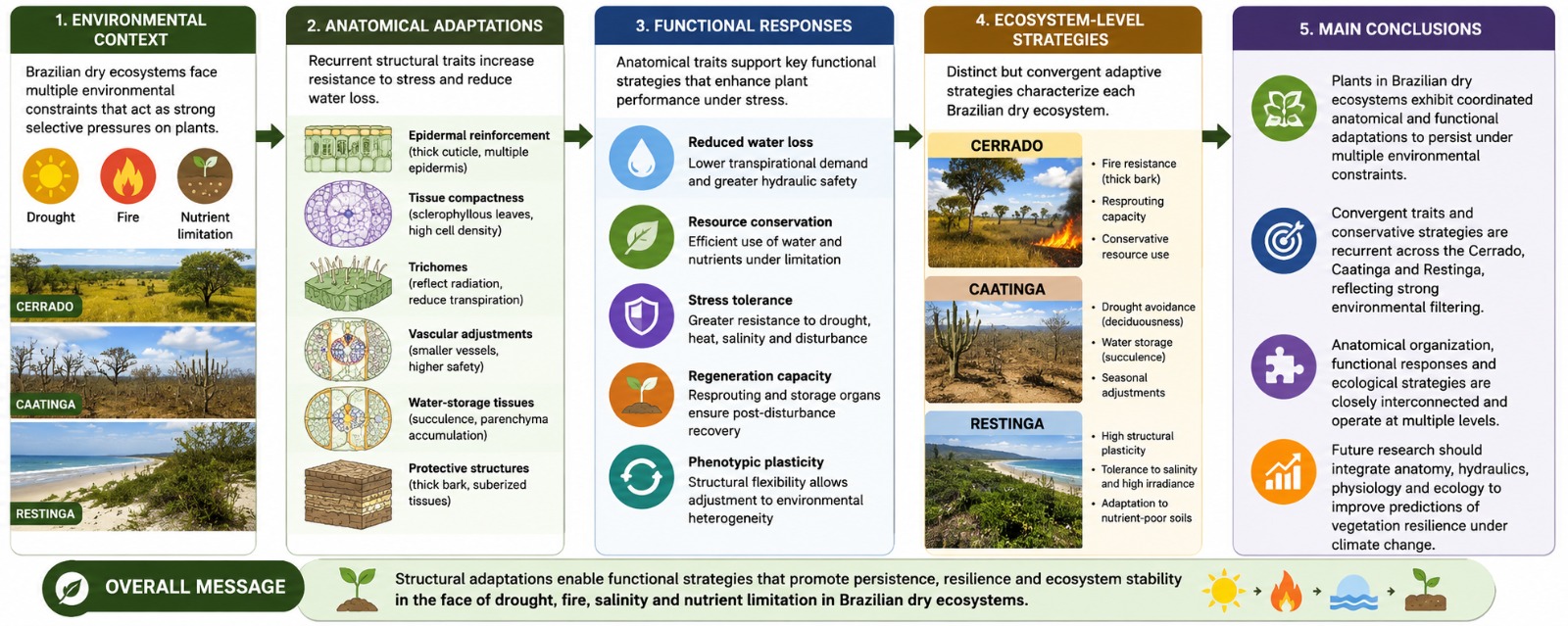
This study aimed to synthesize and discuss the main structural and ecological mechanisms that enable plant persistence in Brazilian dry environments, with emphasis on the Cerrado, Caatinga, and Restinga ecosystems. An integrative literature review combined with a descriptive bibliometric analysis was conducted using studies published between 1992 and 2024, retrieved from major scientific databases. The review followed PRISMA-based procedures and included 29 eligible studies addressing anatomical, physiological, and ecological responses to environmental stress. The results revealed recurrent xeromorphic characteristics, including cuticular thickening, trichome occurrence, compact mesophyll organization, epidermal reinforcement, and tissue sclerification, which contribute to water conservation and environmental resistance. Conservative functional strategies, phenotypic plasticity, adaptive convergence, and drought-avoidance mechanisms were also frequently reported across the analyzed ecosystems. The findings indicate that plant survival under restrictive conditions depends on the integration of anatomical organization, functional traits, and ecological strategies. Furthermore, similar environmental pressures promote convergent adaptive responses among distinct biomes, highlighting the importance of these mechanisms for ecosystem resilience under ongoing climate change.
References
Aguiar-Dias, A. C. A., Yamamoto, K., & Castro, M. M. (2012). Anatomia foliar de cinco espécies de Polygala de restinga e cerrado. Rodriguésia, 63(2), 395–404. https://doi.org/10.1590/S2175-78602012000200012
Ackerly, D. D. (2004). Functional strategies of chaparral shrubs in relation to seasonal water deficit and disturbance. Ecological Monographs, 74(1), 25–44. https://doi.org/10.1890/03-4022
Alvarez, A. S., & Silva, R. J. F. (2012). Anatomia foliar de espécies de Eugenia L. (Myrtaceae) oriundas da restinga de Algodoal/Maiandeua-Pará. INSULA Revista de Botânica, 41, 83–95. https://doi.org/10.5007/2178-4574.2012n41p83
Chaves, M. M., Maroco, J. P., & Pereira, J. S. (2003). Understanding plant responses to drought: From genes to the whole plant. Functional Plant Biology, 30(3), 239–264. https://doi.org/10.1071/FP02076
Cornelissen, J. H. C., Lavorel, S., Garnier, E., Díaz, S., Buchmann, N., Gurvich, D. E., Reich, P. B., ter Steege, H., Morgan, H. D., van der Heijden, M. G. A., Pausas, J. G., & Poorter, H. (2003). A handbook of protocols for standardized and easy measurement of plant functional traits worldwide. Australian Journal of Botany, 51(4), 335–380. https://doi.org/10.1071/BT02124
Díaz, S., & Cabido, M. (2001). Vive la difference: Plant functional diversity matters to ecosystem processes. Trends in Ecology and Evolution, 16(11), 646–655. https://doi.org/10.1016/S0169-5347(01)02283-2
Donato, A. M., & Morretes, B. L. (2007). Anatomia foliar de Eugenia brasiliensis Lam. Proveniente de áreas de restinga e de floresta. Revista Brasileira de Farmacognosia, 17(3), 426–443. https://doi.org/10.1590/S0102-695X2007000300018
Evert, R. F. (2006). Esau’s Plant Anatomy: Meristems, Cells, and Tissues of the Plant Body: Their Structure, Function, and Development (3rd ed.). John Wiley & Sons.
Fahn, A., & Cutler, D. F. (1992). Xerophytes. Gebrüder Borntraeger.
Haridasan, M. (2008). Nutritional adaptations of native plants of the Cerrado biome in acid soils. Brazilian Journal of Plant Physiology, 20(3), 183–195. https://doi.org/10.1590/S1677-04202008000300003
Hoffmann, W. A., Geiger, E. L., Gotsch, S. G., Rossatto, D. R., Silva, L. C. R., Lau, O. L., Haridasan, M., & Franco, A. C. (2012). Ecological thresholds at the savanna-forest boundary: How plant traits, resources and fire govern the distribution of tropical biomes. Ecology Letters, 15(7), 759–768. https://doi.org/10.1111/j.1461-0248.2012.01789.x
Kuster, V. C., Silva, L. C., Meira, R. M. S. A., & Azevedo, A. A. (2018). Structural adaptation and anatomical convergence in stems and roots of five plant species from a Restinga sand coastal plain. Flora, 243, 77–87. https://doi.org/10.1016/j.flora.2018.03.017
Lemos, V. O. T., Lucena, E. M. P., Bonilla, O. H., Edson-Chaves, B., & Freitas, M. A. (2020). Anatomia ecológica foliar de Myrcia guianensis (Aubl.) DC. Na Restinga cearense. Ciência Florestal, 30(2), 307–322. https://doi.org/10.5902/1980509830997
Melo Jr., J. C., Gonçalves, T., & Jardim, R. (2019). Adaptações estruturais e potencial plástico de Schinus terebinthifolia Raddi (Anacardiaceae) em diferentes formações de restinga. Revista Brasileira de Geografia Física, 12(6), 2218–2238. https://doi.org/10.26848/rbgf.v12.6.p2218-2238
Miranda, H. S., Bustamante, M. M. C., & Miranda, A. C. (2002). The fire factor. In P. S. Oliveira & R. J. Marquis (Eds.), The Cerrados of Brazil: Ecology and Natural History of a Neotropical Savanna (pp. 51–68). Columbia University Press.
Page, M. J., McKenzie, J. E., Bossuyt, P. M., Boutron, I., Hoffmann, T. C., Mulrow, C. D., Shamseer, L., Tetzlaff, J. M., Akl, E. A., Brennan, S. E., Chou, R., Glanville, J., Grimshaw, J. M., Hróbjartsson, A., Lalu, M. M., Li, T., Loder, E. W., Mayo-Wilson, E., McDonald, S., McGuinness, L. A., Stewart, L. A., Thomas, J., Tricco, A. C., Welch, V. A., Whiting, P., & Moher, D. (2021). The PRISMA 2020 statement: An updated guideline for reporting systematic reviews. BMJ, 372, n71. https://doi.org/10.1136/bmj.n71
Prado, D. E. (2003). As caatingas da América do Sul. In I. R. Leal, M. Tabarelli, & J. M. C. Silva (Eds.), Ecologia e conservação da Caatinga (pp. 3–73). Editora Universitária UFPE.
Reich, P. B. (2014). The world-wide “fast-slow” plant economics spectrum: A traits manifesto. Journal of Ecology, 102(2), 275–301. https://doi.org/10.1111/1365-2745.12211
Richetti, E., Poletto, A., Rodrigues, A., Oliveira, F. M., & Garibotti-Lusa, M. (2024). Anatomical adaptations of plants within the southern Brazil coastal sand dunes. Flora, 323, 152661. https://doi.org/10.1016/j.flora.2024.152661
Rossatto, D. R., Kolb, R. M., & Franco, A. C. (2015). Leaf anatomy is associated with the type of growth form in neotropical savanna plants. Botany, 93(8), 507–518. https://doi.org/10.1139/cjb-2015-0001
Santos, M. G., Oliveira, M. T., Figueiredo, K. V., Falcão, H. M., Arruda, E. C. P., Almeida-Cortez, J., Sampaio, E. V. S. B., Ometto, J. P. H. B., Menezes, R. S. C., Oliveira, A. F. M., Pompelli, M. F., & Antonino, A. C. D. (2014). Caatinga, the Brazilian dry tropical forest: Can it tolerate climate changes? Theoretical and Experimental Plant Physiology, 26(1), 83–99. https://doi.org/10.1007/s40626-014-0008-0
Scarano, F. R. (2002). Structure, function and floristic relationships of plant communities in stressful habitats marginal to the Brazilian Atlantic rainforest. Annals of Botany, 90(4), 517–524. https://doi.org/10.1093/aob/mcf189
Scarano, F. R. (2009). Plant communities at the periphery of the Atlantic rain forest: Rare-species bias and its risks for conservation. Biological Conservation, 142(6), 1201–1208. https://doi.org/10.1016/j.biocon.2009.02.027
Scarano, F. R., Barros, C. F., Loh, R. K., Mattos, E. A., & Wendt, T. (2009). Plant morpho-physiological variation under distinct environmental extremes in Restinga vegetation. Rodriguésia, 60(1), 221–235. https://doi.org/10.1590/2175-7860200960113
Silva, J. M. C., Leal, I. R., & Tabarelli, M. (2017). Caatinga: The Largest Tropical Dry Forest Region in South America. Springer. https://doi.org/10.1007/978-3-319-68339-3
Simon, M. F., Grether, R., Queiroz, L. P., Skema, C., Pennington, R. T., & Hughes, C. E. (2009). Recent assembly of the Cerrado, a neotropical plant diversity hotspot, by in situ evolution of adaptations to fire. Proceedings of the National Academy of Sciences of the United States of America, 106(48), 20359–20364. https://doi.org/10.1073/pnas.0903410106
Smith, W. K., Vogelmann, T. C., DeLucia, E. H., Bell, D. T., & Shepherd, K. A. (1997). Leaf form and photosynthesis. BioScience, 47(11), 785–793. https://doi.org/10.2307/1313100
Souza, L. S., Barbosa, M. R. V., & Nascimento, K. S. (2023). Estratégias adaptativas à limitada disponibilidade hídrica em espécies arbóreas da Caatinga. Multidisciplinary Sciences Reports, 3(3), 1–22. https://doi.org/10.54038/ms.v3i3.43
Violle, C., Navas, M. L., Vile, D., Kazakou, E., Fortunel, C., Hummel, I., & Garnier, E. (2007). Let the concept of trait be functional! Oikos, 116(5), 882–892. https://doi.org/10.1111/j.2007.0030-1299.15559.x
Wright, I. J., Reich, P. B., Westoby, M., et al. (2004). The worldwide leaf economics spectrum. Nature, 428, 821–827. https://doi.org/10.1038/nature02403
Zupic, I., & Čater, T. (2015). Bibliometric methods in management and organization. Organizational Research Methods, 18(3), 429–472. https://doi.org/10.1177/1094428114562629
Downloads
Published
How to Cite
Issue
Section
License
Copyright (c) 2026 Esther Rodrigues Alves dos Reis

This work is licensed under a Creative Commons Attribution 4.0 International License.
Authors who publish with this journal agree to the following terms:
1) Authors retain copyright and grant the journal right of first publication with the work simultaneously licensed under a Creative Commons Attribution License that allows others to share the work with an acknowledgement of the work's authorship and initial publication in this journal.
2) Authors are able to enter into separate, additional contractual arrangements for the non-exclusive distribution of the journal's published version of the work (e.g., post it to an institutional repository or publish it in a book), with an acknowledgement of its initial publication in this journal.
3) Authors are permitted and encouraged to post their work online (e.g., in institutional repositories or on their website) prior to and during the submission process, as it can lead to productive exchanges, as well as earlier and greater citation of published work.