From demonstration to adoption: Participatory agroforestry transition in East Java, Indonesia
DOI:
https://doi.org/10.14295/cerrado.v3i2.878Keywords:
agroforestry adoption, demonstration plot, institutional mediation, participatory action research, social learning, organic waste utilization, eco-enzymeAbstract
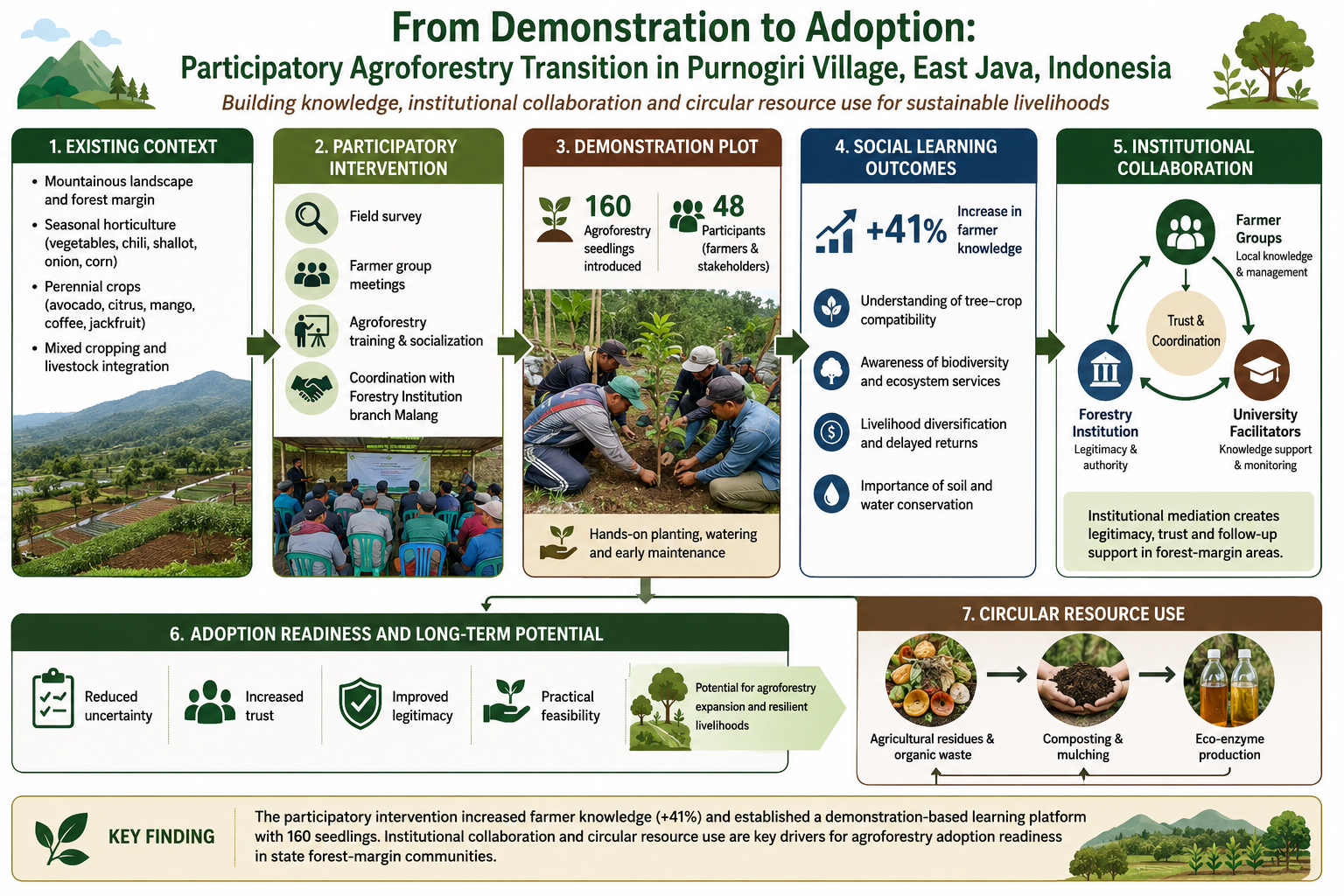
Agroforestry is frequently presented as an integrative land-use option for combining agricultural production, livelihood diversification, and ecological repair. In contrast, farmers in forest-dominated environments rarely use tree-based systems only according to the availability of technical knowledge. Adoption is shaped by cash-flow uncertainty, labor requirements, access legitimacy, institutional support, and the credibility of local evidence. This study examines an early-stage participatory agroforestry intervention in Purnogiri village, Batu City, Indonesia, where farmer groups, Forestry Institution Malang district, and university facilitators jointly introduced demonstration-based tree-crop learning. Using participatory action research and qualitative case-study analysis, the study draws on field observation, focus group discussion, stakeholder coordination records, and intervention documentation. The intervention engaged 48 informants, introduced 160 agroforestry seedlings, and documented a 41% increase in farmer knowledge after socialization and field demonstration. The documented informant profile indicates middle-aged smallholder actors, with age ranging from 45 to 65 years, Elementary School to Senior High School education, 5 to 25 years of farming experience, and 0.5 to 2.0 ha of managed farmland. The strengthened analysis further situates the case within Batu City's smallholder horticultural economy, farmer-group and extension networks, and circular organic-resource potential, including the use of crop residues, fruit and vegetable waste, manure, composting, mulching and eco-enzyme preparation as complementary soil-management practices. The findings show that local readiness did not emerge from training alone, but from the interaction of four mechanisms: livelihood-compatible tree-crop design, demonstration-based social learning, institutional mediation and circular resource use. Existing intercropping experience created an entry point for agroforestry, while Forestry Institution-university-farmer collaboration reduced uncertainty around legitimacy and facilitation. The paper contributes to agroforestry adoption studies by showing that early adoption in state forest margins is a negotiated social and institutional process rather than a one-off transfer of technology. Longitudinal monitoring is still needed to verify seedling survival, management continuity, income effects, residue utilization, and ecological outcomes.
References
Amare, D., & Darr, D. Agroforestry adoption as a systems concept: a review. Forest Policy and Economics, 120, 102299, 2020. https://doi.org/10.1016/j.forpol.2020.102299
Awazi, N. P., Ngoma, C. R. M., Temgoua, L. F., Tientcheu-Avana, M.-L., Zanguim, H., Baro, D., & Tchamba, M. N. A comparative study of agroforestry adoption as a climate change adaptation option in the Republic of Congo and Chad. Discover Forests, 1, 50, 2025. https://doi.org/10.1007/s44415-025-00050-z
Badan Pusat Statistik Kota Batu. Hasil Pencacahan Lengkap Sensus Pertanian 2023 - Tahap I Kota Batu. Batu: BPS Kota Batu, 2023. https://batukota.bps.go.id/id/publication/2023/12/15/17ac17a0eb4811cbd778fb04/hasil-pencacahan-lengkap-sensus-pertanian-2023-tahap-i-kota-batu.html
Badan Pusat Statistik Kota Batu. Statistik Hortikultura Kota Batu 2023. Batu: BPS Kota Batu, 2024. https://batukota.bps.go.id/id/publication/2024/12/11/c2a6a72036a077ddef4cb872/statistik-hortikultura-kota-batu-2023.html
Barbon, W. J. J., Myae, C. M. C., Vidallo, R., Thant, P. S. P. S., Monville-Oro, E. M., & Gonsalves, J. Applying participatory action research methods in community-based adaptation with smallholders in Myanmar. Frontiers in Climate, 3, 734053, 2021. https://doi.org/10.3389/fclim.2021.734053
Bhandari, S., Paudel, S., & Upadhaya, S. Socio-economic and environmental benefits of agroforestry and its multilevel barriers to adoption: a systematic review. Sustainability, 18(1), 5, 2026. https://doi.org/10.3390/su18010005
Braun, V., & Clarke, V. Using thematic analysis in psychology. Qualitative Research in Psychology, 3(2), 77-101, 2006. https://doi.org/10.1191/1478088706qp063oa
ECOTON. HPSN 2026 jadi momentum besar, DLH Kota Batu gaspol kawasan zero waste Desa Oro-Oro Ombo. Gresik: Ecological Observation and Wetlands Conservation, 2026. https://ecoton.or.id/hpsn-2026-jadi-momentum-besar-dlh-kota-batu-gaspol-kawasan-zero-waste-desa-oro-oro-ombo/
Government of Indonesia. Peraturan Menteri Lingkungan Hidup dan Kehutanan Nomor 9 Tahun 2021 tentang Pengelolaan Perhutanan Sosial. Jakarta: Kementerian Lingkungan Hidup dan Kehutanan, 2021. https://peraturan.bpk.go.id/Details/235324/permen-lhk-no-9-tahun-2021
Kurniasih, H., Ford, R. M., Keenan, R. J., & King, B. The evolution of community forestry through the growth of interlinked community institutions in Java, Indonesia. World Development, 139, 105319, 2021. https://doi.org/10.1016/j.worlddev.2020.105319
Lujan Soto, R., de Vente, J., & Cuellar Padilla, M. Learning from farmers’ experiences with participatory monitoring and evaluation of regenerative agriculture based on visual soil assessment. Journal of Rural Studies, 88, 192-204, 2021. https://doi.org/10.1016/j.jrurstud.2021.10.017
MalangVoice. Hasil survei pertanian 2023, Kota Batu didominasi petani gurem. MalangVoice, 2024. https://malangvoice.com/hasil-survei-pertanian-2023-kota-batu-didominasi-petani-gurem/
Mponela, P., Manda, J., Kinyua, M., & Kihara, J. The impact of participatory action research and endogenous integrated soil fertility management on farm-gate dietary outputs in northern Tanzania. Heliyon, 9, e21888, 2023. https://doi.org/10.1016/j.heliyon.2023.e21888
Mukhlis, I., Rizaludin, M. S., & Hidayah, I. Understanding socio-economic and environmental impacts of agroforestry on rural communities. Forests, 13(4), 556, 2022. https://doi.org/10.3390/f13040556
Nabila, R., Tamami, N. D. B., Sugiarti, T., & Widodo, S. Analisis faktor-faktor yang memengaruhi pendapatan usahatani apel di Desa Tulungrejo Kecamatan Bumiaji Kota Batu. Agriscience, 4(2), 396-415, 2023. https://journal.trunojoyo.ac.id/agriscience/article/view/21199
Octavia, D., Suharti, S., Murniati, Dharmawan, I. W. S., Nugroho, H. Y. S. H., Supriyanto, B., Rohadi, D., Njurumana, G. N., Yeny, I., Hani, A., Mindawati, N., Suratman, Adalina, Y., Prameswari, D., Hadi, E. E. W., & Ekawati, S. Mainstreaming smart agroforestry for social forestry implementation to support sustainable development goals in Indonesia: a review. Sustainability, 14(15), 9313, 2022. https://doi.org/10.3390/su14159313
Radio Republik Indonesia. Tahun 2025, timbulan sampah Kota Batu turun signifikan. RRI Malang, 2025. https://rri.co.id/malang/regional/2074344/about.html
Sasmita, A., Sari, T. P., Febrina, L., & Utomo, B. Pelatihan pemanfaatan sampah organik menjadi eco-enzyme pada masyarakat Desa Batu Belah. Jurnal Abdi Masyarakat Indonesia, 5(2), 583-590, 2025. https://doi.org/10.54082/jamsi.1773
Situmorang, R. O., Sanudin, Widiyanto, A., & Fauziyah, E. Assessment of community sustainability on social forestry program implementation in Indonesia: insights from agroforestry model in Java and Sumatra. Trees, Forests and People, 23, 101124, 2026. https://doi.org/10.1016/j.tfp.2025.101124
Sseguya, H., Robinson, D. S., Mwango, H. R., Flock, J. A., Manda, J., Abed, R., & Mruma, S. O. The impact of demonstration plots on improved agricultural input purchase in Tanzania: implications for policy and practice. PLOS ONE, 16(1), e0243896, 2021. https://doi.org/10.1371/journal.pone.0243896
Sutherland, L.-A., & Marchand, F. On-farm demonstration: enabling peer-to-peer learning. The Journal of Agricultural Education and Extension, 27(5), 573-590, 2021. https://doi.org/10.1080/1389224X.2021.1959716
Tranchina, M., Reubens, B., Frey, M., Mele, M., & Mantino, A. What challenges impede the adoption of agroforestry practices? A global perspective through a systematic literature review. Agroforestry Systems, 98, 1817-1837, 2024. https://doi.org/10.1007/s10457-024-00993-w
Wijayanto, H. W., Nurrochmat, D. R., & Santoso, H. Does agroforestry adoption affect subjective well-being? Empirical evidence from smallholder farmers. Sustainability, 14(16), 10382, 2022. https://doi.org/10.3390/su141610382
World Bank. Indonesia - Strengthening of Social Forestry in Indonesia Project. Project ID: P165742. World Bank, Washington, DC, 2020. https://projects.worldbank.org/en/projects-operations/project-detail/P165742
Downloads
Published
How to Cite
Issue
Section
License
Copyright (c) 2026 Medea Rahmadhani Utomo, Asihing Kustanti, Ajik Siswantoro, Fitrotul Laili

This work is licensed under a Creative Commons Attribution 4.0 International License.
Authors who publish with this journal agree to the following terms:
1) Authors retain copyright and grant the journal right of first publication with the work simultaneously licensed under a Creative Commons Attribution License that allows others to share the work with an acknowledgement of the work's authorship and initial publication in this journal.
2) Authors are able to enter into separate, additional contractual arrangements for the non-exclusive distribution of the journal's published version of the work (e.g., post it to an institutional repository or publish it in a book), with an acknowledgement of its initial publication in this journal.
3) Authors are permitted and encouraged to post their work online (e.g., in institutional repositories or on their website) prior to and during the submission process, as it can lead to productive exchanges, as well as earlier and greater citation of published work.