Integrated drought tolerance strategies in Cerrado plants and their agricultural implications
DOI:
https://doi.org/10.14295/cerrado.v3i2.874Keywords:
Plant Ecophysiology, Water Stress, Functional Traits, Water Use Efficiency, Tropical SavannasAbstract
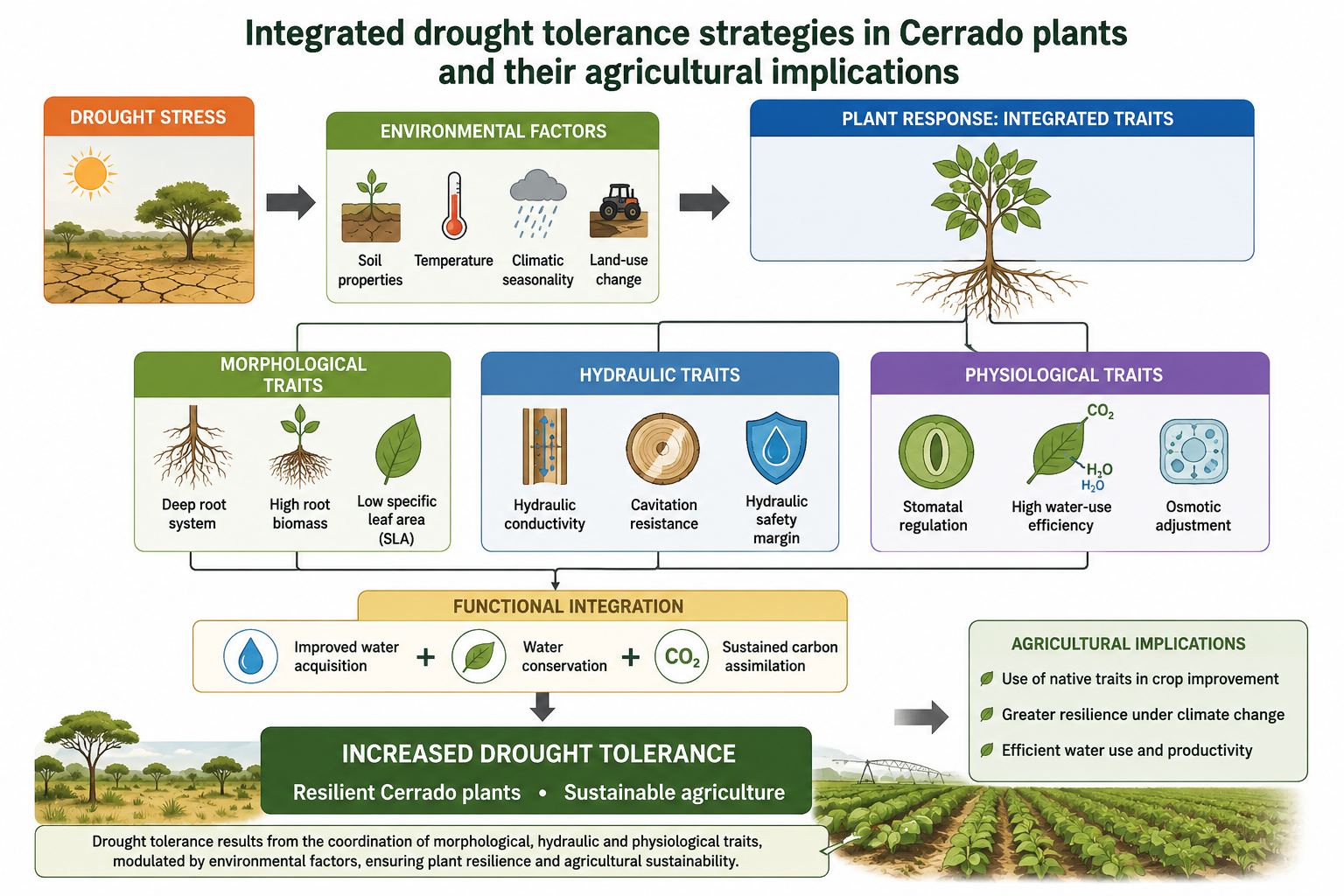
Drought tolerance in plants arises from coordinated interactions among morphological, hydraulic, and physiological processes that regulate water acquisition, transport, and conservation under water-limited conditions. This study aimed to synthesize and critically evaluate functional strategies associated with drought tolerance In Cerrado plants and their implications for agricultural systems. An Integrative literature review was conducted following PRISMA-based guidelines, using Web of Science, Scopus, ScienceDirect, and SciELO. Studies published between 2004 and 2024 were considered, resulting in”28 selected articles after screening and eligibility assessment. The results Indicate that deep root systems, hydraulic safety mechanisms, stomatal regulation, and osmotic adjustment are key components of drought responses. Trade-offs between hydraulic efficiency and safety, and between water conservation and carbon assimilation, were consistently reported. Environmental factors, particularly soil properties and climatic seasonality, strongly modulate these responses. This study demonstrates that drought tolerance depends on functional coordination rather than Isolated traits, providing a more integrative framework for understanding plant resilience under climate change.
References
Alves, V., Torres, J. L., Lana, R., & Pinheiro, M. Nutrient cycling between soil and leaf litter in the Cerrado (Brazilian savanna) on eutrophic and dystrophic Neosols. Acta Botanica Brasilica, 32, 169–179, 2018. https://doi.org/10.1590/0102-33062017abb0369.
Bartlett, M., Klein, T., Jansen, S., Choat, B., & Sack, L. The correlations and sequence of plant stomatal, hydraulic, and wilting responses to drought. Proceedings of the National Academy of Sciences, 113, 13098–13103, 2016. https://doi.org/10.1073/pnas.1604088113.
Bertolino, L., Caine, R., & Gray, J. Impact of stomatal density and morphology on water-use efficiency in a changing world. Frontiers in Plant Science, 10, 225, 2019. https://doi.org/10.3389/fpls.2019.00225.
Blackman, C., Creek, D., Maier, C., et al. Drought response strategies and hydraulic traits contribute to mechanistic understanding of plant dry-down to hydraulic failure. Tree Physiology, 39, 910–924, 2019. https://doi.org/10.1093/treephys/tpz016.
Blum, A. Osmotic adjustment is a prime drought stress adaptive engine in support of plant production. Plant, Cell & Environment, 40, 4–10, 2017. https://doi.org/10.1111/pce.12800.
Bucci, S., Scholz, F., Goldstein, G., et al. Water relations and hydraulic architecture in Cerrado trees. Brazilian Journal of Plant Physiology, 20, 2008. https://doi.org/10.1590/S1677-04202008000300007.
Chaves, M., Flexas, J., & Pinheiro, C. Photosynthesis under drought and salt stress. Annals of Botany, 103, 551–560, 2009. https://doi.org/10.1093/aob/mcn125.
Choat, B., Jansen, S., Brodribb, T., et al. Global convergence in the vulnerability of forests to drought. Nature, 491, 752–755, 2012. https://doi.org/10.1038/nature11688.
Cianciaruso, M., Silva, I., Manica, L., & Souza, J. Leaf habit does not predict leaf functional traits in cerrado woody species. Basic and Applied Ecology, 14, 404–412, 2013. https://doi.org/10.1016/j.baae.2013.05.002.
Colli, G., & Vieira, C. Biodiversity and conservation of the Cerrado. Biodiversity and Conservation, 29, 2020. https://doi.org/10.1007/s10531-020-01967-x.
Du, Y., Niu, W., Gu, X., et al. Crop yield and water use efficiency under aerated irrigation. Agricultural Water Management, 210, 158–164, 2018. https://doi.org/10.1016/j.agwat.2018.07.038.
Franco, A., Bustamante, M., Caldas, L., et al. Leaf functional traits of Neotropical savanna trees. Trees, 19, 326–335, 2005. https://doi.org/10.1007/s00468-004-0394-z.
Fushimi, M., Lima, G., & Capoane, V. Changes in land use and cover and their environmental impacts in the Cerrado. Sustainability, 16, 4266, 2024. https://doi.org/10.3390/su16104266.
Hoffmann, W., Franco, A., Moreira, M., & Haridasan, M. Specific leaf area explains differences in leaf traits between congeneric savanna and forest trees. Functional Ecology, 19, 932–940, 2005. https://doi.org/10.1111/j.1365-2435.2005.01045.x.
Klein, T. The variability of stomatal sensitivity to leaf water potential. Functional Ecology, 28, 1313–1320, 2014. https://doi.org/10.1111/1365-2435.12289.
Kühnhammer, K., van Haren, J., Kübert, A., et al. Deep roots mitigate drought impacts. Science of the Total Environment, 893, 164763, 2023. https://doi.org/10.1016/j.scitotenv.2023.164763.
Martins, D., Nascimento, D., Abrahão, A., et al. Soil properties and geomorphic processes influence vegetation in the Cerrado. Plant and Soil, 476, 549–588, 2022. https://doi.org/10.1007/s11104-022-05517-y.
Oliveira, R., Bezerra, L., Davidson, E., et al. Deep root function in soil water dynamics in cerrado savannas. Functional Ecology, 19, 574–581, 2005. https://doi.org/10.1111/j.1365-2435.2005.01003.x.
Oliveira, V., Silva, E., & Carvalho, M. Elevated CO₂ minimizes drought effects in Cerrado species. Frontiers in Plant Science, 7, 810, 2016. https://doi.org/10.3389/fpls.2016.00810.
Pinheiro, R. C., et al. Roots take up labeled nitrogen from a depth of 9 m in a wooded savanna in Brazil. Soil Biology and Biochemistry, 160, 108282, 2021. https://doi.org/10.1016/j.soilbio.2021.108282.
Qiao, M., Hong, C., Jiao, Y., et al. Impacts of drought on photosynthesis in major food crops. Plants, 13, 1808, 2024. https://doi.org/10.3390/plants13131808.
Reich, P. The world-wide fast–slow plant economics spectrum. Journal of Ecology, 102, 275–301, 2014. https://doi.org/10.1111/1365-2745.12211.
Reis, L., Mesquita, M., Carvalho, P., & Miranda, S. Atributos funcionais de espécies do Cerrado. Enciclopédia Biosfera, 19, 2022. https://doi.org/10.18677/EnciBio_2022B6.
Takahashi, F., Kuromori, T., Urano, K., et al. Drought stress responses in plants. Frontiers in Plant Science, 11, 556972, 2020. https://doi.org/10.3389/fpls.2020.556972.
Tardieu, F., Simonneau, T., & Muller, B. The physiological basis of drought tolerance in crop plants. Annual Review of Plant Biology, 69, 733–759, 2018. https://doi.org/10.1146/annurev-arplant-042817-040218.
Wright, I., Reich, P., Westoby, M., et al. The worldwide leaf economics spectrum. Nature, 428, 821–827, 2004. https://doi.org/10.1038/nature02403.
Yan, C. L., Ni, M. Y., Cao, K. F., & Zhu, S. D. Leaf hydraulic safety margin and trade-off. Biology Letters, 16, 20200456, 2020. https://doi.org/10.1098/rsbl.2020.0456.
Zandalinas, S., Mittler, R., & Balfagón, D., et al. Plant adaptations to drought and heat. Physiologia Plantarum, 162, 2017. https://doi.org/10.1111/ppl.12540.
Downloads
Published
How to Cite
Issue
Section
License
Copyright (c) 2026 Esther Rodrigues Alves dos Reis

This work is licensed under a Creative Commons Attribution 4.0 International License.
Authors who publish with this journal agree to the following terms:
1) Authors retain copyright and grant the journal right of first publication with the work simultaneously licensed under a Creative Commons Attribution License that allows others to share the work with an acknowledgement of the work's authorship and initial publication in this journal.
2) Authors are able to enter into separate, additional contractual arrangements for the non-exclusive distribution of the journal's published version of the work (e.g., post it to an institutional repository or publish it in a book), with an acknowledgement of its initial publication in this journal.
3) Authors are permitted and encouraged to post their work online (e.g., in institutional repositories or on their website) prior to and during the submission process, as it can lead to productive exchanges, as well as earlier and greater citation of published work.