Populations are not continuous ecological units
DOI:
https://doi.org/10.14295/cerrado.v3i2.841Keywords:
fragmentation, landscape connectivity, spatial structure, alpha-hull, Chrysocyon brachyurusAbstract
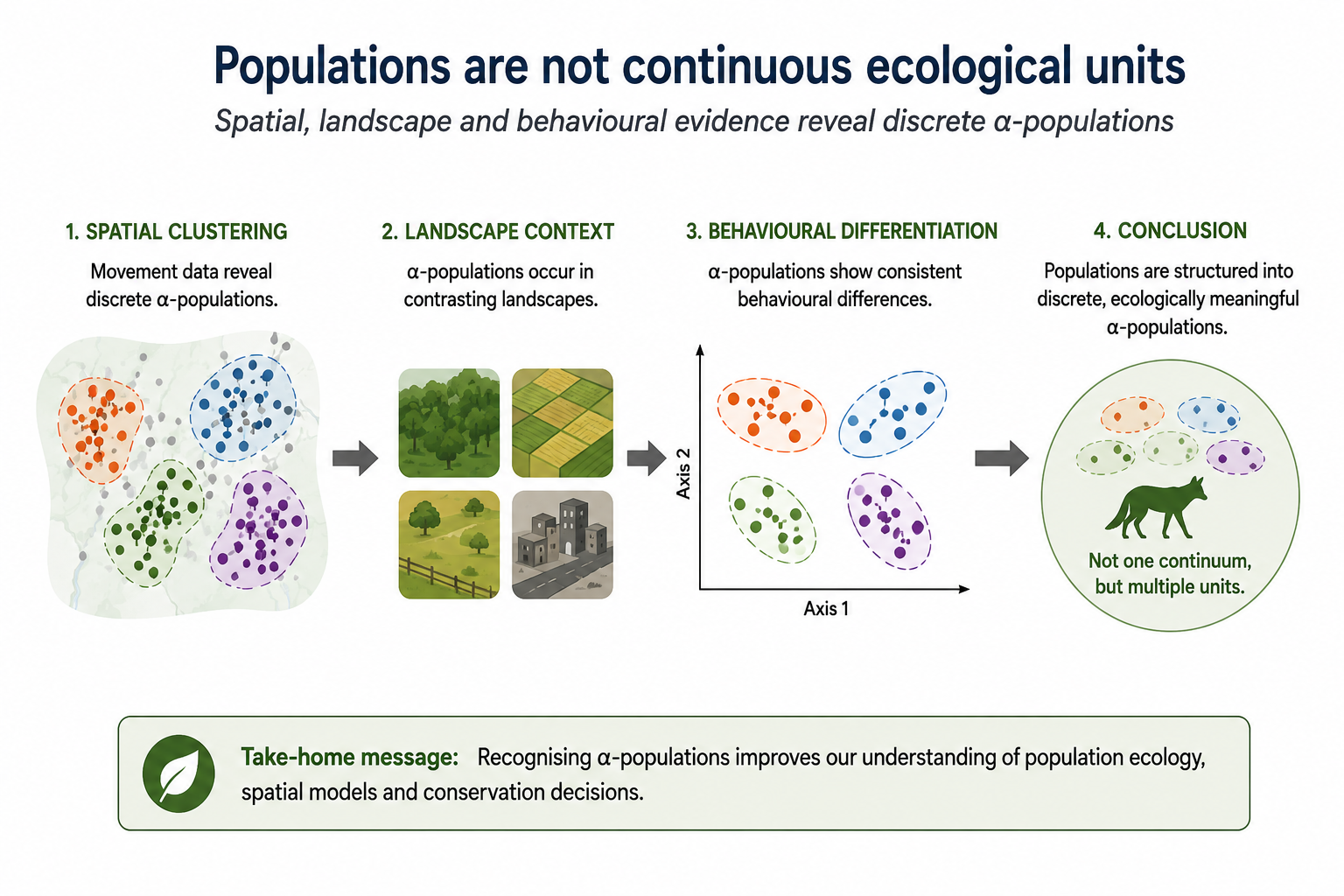
Ecological populations are typically treated as continuous units, implicitly assumed to occupy homogeneous environments and to respond uniformly to ecological pressures. However, spatial analyses have shown that populations can be structured into discrete spatial units, raising the question of whether such units represent meaningful ecological entities. Here, we integrate spatial clustering, land-use and land-cover composition, and behavioural data to evaluate the ecological relevance of α-populations within a widely distributed mammal population. We show that α-populations are embedded in contrasting landscape contexts and exhibit consistent behavioural differentiation, despite behavioural measurements being obtained under standardized conditions. Multivariate analyses revealed congruent structuring of landscape and behaviour at the α-population level, with limited overlap among units. Together, these results provide evidence that α-p represent a useful operational frameworks for capturing internal population heterogeneity, suggesting that populations may not function as continuous ecological units. Recognising this hidden structure has implications for population ecology, spatial modelling and conservation assessments.
References
Bloche, D. A. F., Thorup, K., Olsen, K., Ekberg, P., Ellegaard Larsen, P., Strange, K.-E., & Tøttrup, A. P. Breeding biology of Red-backed Shrikes (Lanius collurio): Distribution, performance and post-fledging survival in Denmark. Ornis Fennica, 100(2), 69–83, 2023. DOI:10.51812/of.124729.
Brito, L. J. M., de Azevedo, C. S., Dutra, L. M. L., Leme, F. O. P., & Vasconcellos, A. S. Maned wolves (Chrysocyon brachyurus) differ in their responses to environmental enrichment: Why? Applied Animal Behaviour Science, 280, 106432, 2024. DOI:10.1016/j.applanim.2024.106432.
Brito, L. d. J. M. d. The Short-Tailed Golden Dog Fragmented Realm: α-Hull Unravels the Maned Wolf’s Hidden Population. Wild, 3(1), 4, 2026. DOI:10.3390/wild3010004.
Brito, L. J. M., Gomes, P. D., Rosa, G. B., & Freitas, V. S. Comportamento e biologia reprodutiva de fêmea de lobo-guará (Chrysocyon brachyurus Illiger, 1815) sob cuidados humanos. Brazilian Journal of Science, 1(5), 65–75, 2022. DOI:10.14295/bjs.v1i5.82.
Brito, L. J. M., & Garbino, G. S. T. Occurrence and distribution of sarcoptic mange in wild Neotropical canids. Medical and Veterinary Entomology, 1–9, 2026. DOI:10.1111/mve.70085.
Consorte-McCrea, A. G., & Santos, E. F. Ecology and conservation of the maned wolf. In: Ecology and conservation of the maned wolf, CRC Press, Boca Raton, pp: —, 2013.
Cruz, L. R., Muylaert, R. L., Galetti, M., & Pires, M. M. The geography of diet variation in Neotropical Carnivora. Mammal Review, 52, 112–128, 2022.
Dingemanse, N. J., & Réale, D. Natural selection and animal personality. Behaviour, 142(9–10), 1159–1184, 2005.
Droghei, S., Falco, M., & Ciucci, P. Multi-scalar habitat selection unveils ecological domains in wolves when selecting rendezvous sites. Journal of Zoology, 327, 2025.
Edelsbrunner, H., et al. On the shape of a set of points in the plane. IEEE Transactions on Information Theory, 29(4), 551–559, 1983. DOI:10.1109/TIT.1983.1056714.
Ester, M., Kriegel, H.-P., Sander, J., & Xu, X. A density-based algorithm for discovering clusters in large spatial databases with noise. Proceedings of the Second International Conference on Knowledge Discovery and Data Mining (KDD’96), pp: 226–331, 1996.
Fahrig, L. Ecological responses to habitat fragmentation per se. Annual Review of Ecology, Evolution, and Systematics, 48, 1–23, 2017.
Fahrig, L., Arroyo-Rodríguez, V., Bennett, J. R., et al. Is habitat fragmentation bad for biodiversity? Biological Conservation, 230, 179–186, 2019. DOI:10.1016/j.biocon.2018.12.026.
Forman, R. T. T. Land mosaics: The ecology of landscapes and regions. Cambridge University Press, Cambridge, 1995.
Gilarranz, L. J., & Bascompte, J. Spatial network structure and metapopulation persistence. Journal of Theoretical Biology, 297, 11–16, 2012. DOI:10.1016/j.jtbi.2011.11.027.
Hanski, I. Metapopulation dynamics. Nature, 396, 41–49, 1998. DOI:10.1038/23876.
Hertel, A. G., Niemelä, P. T., Dingemanse, N. J., et al. A guide for studying among-individual behavioral variation from movement data in the wild. Movement Ecology, 8, 30, 2020. DOI:10.1186/s40462-020-00216-8.
Hodapp, D., Borer, E. T., Harpole, W. S., et al. Spatial heterogeneity in species composition constrains plant community responses to herbivory and fertilisation. Ecology Letters, 21(9), 1364–1371, 2018. DOI:10.1111/ele.13102.
Kasper, C. B., da Fontoura Rodrigues, M. L., Severo, M. M., et al. The last and endangered maned wolves (Chrysocyon brachyurus) from southern Brazil and Uruguay. Studies on Neotropical Fauna and Environment, 59(3), 920–930, 2024. DOI:10.1080/01650521.2023.2285870.
Kays, R., Crofoot, M. C., Jetz, W., & Wikelski, M. Terrestrial animal tracking as an eye on life and planet. Science, 348(6240), aaa2478, 2015. DOI:10.1126/science.aaa2478.
Kranstauber, B., Cameron, A., Weinzerl, R., et al. The Movebank data model for animal tracking. Environmental Modelling & Software, 26(6), 834–835, 2011. DOI:10.1016/j.envsoft.2010.12.005.
Lamb, C. T., Ford, A. T., McLellan, B. N., et al. The ecology of human-carnivore coexistence. PNAS, 117(30), 17876–17883, 2020. DOI:10.1073/pnas.1922097117.
Levins, R. Some demographic and genetic consequences of environmental heterogeneity for biological control. Bulletin of the Entomological Society of America, 15(3), 237–240, 1969. DOI:10.1093/besa/15.3.237.
Machado, F. S., Moura, A. S., Mariano, R. F., et al. Small mammals in high fragmented landscape in Cerrado/Atlantic Forest ecotone, Southeastern Brazil. Iheringia, Série Zoologia, 111, e2021022, 2021. DOI:10.1590/1678-4766e2021022.
Magioli, M., Ferraz, K. M. P. M. B., Chiarello, A. G., et al. Land-use changes lead to functional loss of terrestrial mammals. Perspectives in Ecology and Conservation, 19(2), 161–170, 2021. DOI:10.1016/j.pecon.2021.02.006.
MacArthur, R. H., & Wilson, E. O. The theory of island biogeography. Princeton University Press, Princeton, 1967.
MapBiomas. Coleção 9 da Série Anual de Mapas de Uso e Cobertura da Terra do Brasil, 2024.
Martins, E. G., Araújo, M. S., Bonato, V., & dos Reis, S. F. Sex and season affect individual-level diet variation. Biotropica, 40(1), 132–135, 2008. DOI:10.1111/j.1744-7429.2007.00319.x.
Mateus, L., Ortega, J., Mendes, A., & Penha, J. Nonlinear effect of density on trophic niche width. Austral Ecology, 41(2), 231–239, 2016. DOI:10.1111/aec.12335.
Muir, M. J., & Emmons, L. H. Conservation. In: The Maned Wolves of Noel Kempff Mercado National Park, Smithsonian Institution Scholarly Press, Washington DC, pp: 91–115, 2012. DOI:10.5479/si.00810282.639.91.
Nathan, R., Getz, W. M., Revilla, E., et al. A movement ecology paradigm. PNAS, 105(49), 19052–19059, 2008. DOI:10.1073/pnas.0800375105.
Nathan, R., Monk, C. T., Arlinghaus, R., et al. Big-data approaches lead to increased understanding of movement ecology. Science, 375(6582), eabg1780, 2022. DOI:10.1126/science.abg1780.
Palmer, M. S., Gaynor, K. M., Becker, J. A., et al. Dynamic landscapes of fear. Trends in Ecology & Evolution, 37(10), 911–925, 2022. DOI:10.1016/j.tree.2022.06.007.
Pantel, J. H., Lamy, T., Dubart, M., et al. Metapopulation dynamics of multiple species. Ecological Monographs, 92(3), e1515, 2022. DOI:10.1002/ecm.1515.
Popovic, G., Mason, T. J., Drobniak, S. M., et al. Four principles for improved statistical ecology. Methods in Ecology and Evolution, 2024. DOI:10.1111/2041-210X.14270.
Ratter, J. A., Bridgewater, S., & Ribeiro, J. F. Biodiversity patterns of woody vegetation of the Cerrado. In: Neotropical savannas and seasonally dry forests, CRC Press, Boca Raton, pp: 61–76, 2006.
Réale, D., Reader, S. M., Sol, D., et al. Integrating animal temperament within ecology and evolution. Biological Reviews, 82(2), 291–318, 2007. DOI:10.1111/j.1469-185X.2007.00010.x.
Rocha, E. C., Brito, D., Silva, P. M., et al. Effects of habitat fragmentation. Biota Neotropica, 18(3), e20170483, 2018. DOI:10.1590/1676-0611-BN-2017-0483.
Rodrigues, F. H. G., Hass, A., Lacerda, A. C. R., et al. Feeding habits of the maned wolf. Mastozoología Neotropical, 14(1), 37–51, 2007.
Sih, A., Bell, A., & Johnson, J. C. Behavioral syndromes. Trends in Ecology & Evolution, 19(7), 372–378, 2004. DOI:10.1016/j.tree.2004.04.009.
Souza, C. M. Jr., Shimbo, J. Z., Rosa, M. R., et al. Reconstructing land-use changes in Brazilian biomes. Remote Sensing, 12(17), 2735, 2020. DOI:10.3390/rs12172735.
Tucker, M. A., Böhning-Gaese, K., Fagan, W. F., et al. Moving in the Anthropocene. Science, 359(6374), 466–469, 2018. DOI:10.1126/science.aam9712.
Turner, M. G., & Gardner, R. H. Landscape ecology in theory and practice: Pattern and process. 2nd Ed., Springer, New York, 2015. DOI:10.1007/978-1-4939-2794-4.
Vynne, C., Keim, J. L., Machado, R. B., et al. Resource selection in wide-ranging mammals. PLOS ONE, 6(12), e28939, 2011. DOI:10.1371/journal.pone.0028939.
Wiens, J. A. Spatial scaling in ecology. Functional Ecology, 3(4), 385–397, 1989. DOI:10.2307/2389612.
Wolf, M., & Weissing, F. J. Animal personalities. Trends in Ecology & Evolution, 27(8), 452–461, 2012. DOI:10.1016/j.tree.2012.05.001.
Downloads
Published
How to Cite
Issue
Section
License
Copyright (c) 2026 Luan de Jesus Matos de Brito

This work is licensed under a Creative Commons Attribution 4.0 International License.
Authors who publish with this journal agree to the following terms:
1) Authors retain copyright and grant the journal right of first publication with the work simultaneously licensed under a Creative Commons Attribution License that allows others to share the work with an acknowledgement of the work's authorship and initial publication in this journal.
2) Authors are able to enter into separate, additional contractual arrangements for the non-exclusive distribution of the journal's published version of the work (e.g., post it to an institutional repository or publish it in a book), with an acknowledgement of its initial publication in this journal.
3) Authors are permitted and encouraged to post their work online (e.g., in institutional repositories or on their website) prior to and during the submission process, as it can lead to productive exchanges, as well as earlier and greater citation of published work.